
SEP 29 2019 | Son of Anarchy S1E1 | Absalom Killed
SEP 29 2019 | Son of Anarchy S1E1 | Absalom Killed
Scripture: 2 Samuel 18:1-10
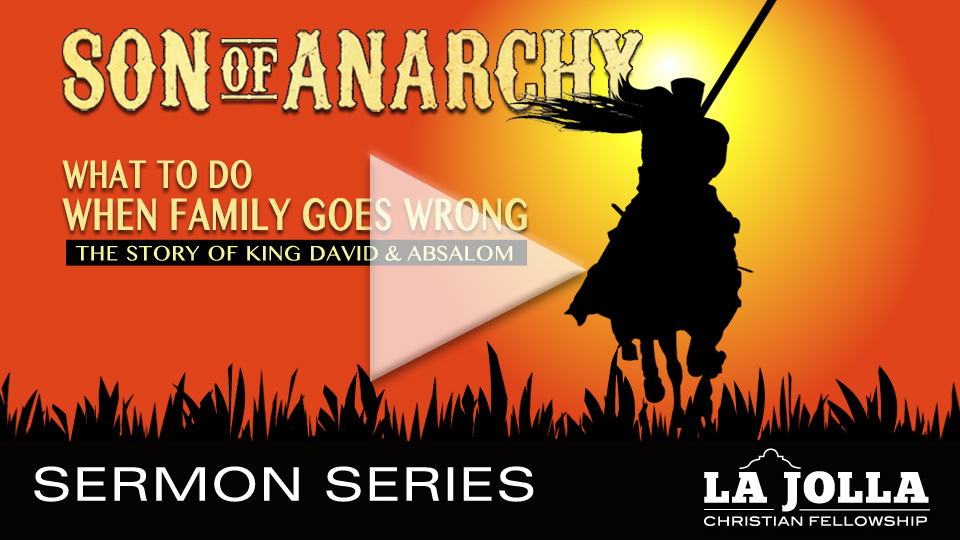
A six week series on the most famously dysfunctional family in Scripture opens at its end. Absalom is dead, killed against David's explicit order, and the king who was told to stay behind because he was worth ten thousand men is about to receive the news.
Pastor Adam's framing is that David was an amazing son of God and a great king, and was not great in regard to family, and that the church is looking at this because it wants to be practical rather than flattering. The instruction David gives before the battle, be gentle with the young man Absalom for my sake, is heard by all the troops and ignored by the man who mattered.
The message names generational consequence as the mechanism. Actions inside a family do not stay inside the moment, and 2 Chronicles 7:14 is offered as the course correction, a promise conditioned on humbling and turning rather than on strategy.
David's own Psalm 3 sits underneath, written when he fled from this son, with its taunt quoted inside it, God will not deliver him, and its answer, that the Lord is a shield around me and the one who lifts my head.
The message reads Absalom's downfall as pride, and asks how a family breaks a pattern rather than passes it down.
This is the first message in Son of Anarchy.
Key topics:
- A great king who was not great at family
- Generational consequence, and how a pattern gets broken rather than passed on
- Psalm 3, written while fleeing this son
Podcast (sermons): Play in new window | Download
Read the Sermon Transcript
Sea Change Church · Son of Anarchy · "Absalom Killed" Pastor Adam Stadtmiller · September 29, 2019
Automated transcript. Not reviewed for accuracy.
Good morning. My name's Harry. I'm the student ministries pastor on staff, and I'll be reading the scripture for today. Today's scripture is from 2 Samuel 18, 1 through 10. David mustered the men who were with him and appointed over them commanders of thousands and commanders of hundreds. David sent out his troops, a third under the command of Joab, a third under Joab's brother Abishai, son of Zariah, and a third under Ittai the Gittite. The king told the troops, I myself will surely march out with you. But the men said, you must not go out. If we are forced to flee, they won't care about us.
Even if half of us die, they won't care about us. But you are worth 10,000 of us. It would be better now for you to give us support from the city. The king answered, I will do whatever seems best to you. So the king stood beside the gate while all his men marched out in units of hundreds and of thousands. The king commanded Joab, Abishai, and Ittai, be gentle with the young man Absalom for my sake. And all the troops heard the king giving orders concerning Absalom to each of the commanders.
David's army marched out of the city to fight Israel, and the battle took place in the forest of Ephraim. There, Israel's troops were routed by David's men, and the casualties that day were great, 20,000 men. The battle spread out over the whole countryside, and the forest swallowed up more men that day than the sword. Now, Absalom happened to meet David's men. He was riding his mule, and as the mule went under the thick branches of a large oak, Absalom's hair got caught in the tree.
He was left hanging in midair, while the mule he was riding kept on going. When one of the men saw what had happened, he told Joab, I just saw Absalom hanging in an oak tree. Joab said to the man who had told him this, What? You saw him? Why didn't you strike him to the ground right there? Then I would have had to give you ten shekels of silver and a warrior's belt. But the man replied, Even if a thousand shekels were weighted out into my hands, I would not lay a hand on the king's son.
In our hearing, the king commanded you and Abishai and Ittai, protect the young man Absalom for my sake. And if I had had to put my life in jeopardy, and nothing is hidden from the king, you would have kept your distance from me. Joab said, I'm not going to wait like this for you. So he took three javelins in his hand and plunged them into Absalom's heart, while Absalom was still alive in the oak tree. And ten of Joab's armor bearers surrounded Absalom, struck him, and killed him.
Then Joab sounded the trumpet, and the troops stopped pursuing Israel, for Joab halted them. They took Absalom, threw him into a big pit in the forest, and piled up large heaps of rocks over him. Meanwhile, all the Israelites fled to their homes. During his lifetime, Absalom had taken a pillar and erected it in the king's valley as a monument to himself. For he had thought, I have no sons to carry on the memory of my name.
He named the pillar after himself, and called it Absalom's Monument. And it's called Absalom's Monument to this day, the word of the Lord. Thank you, Harry. That was quite a portion of scripture there you had to get into. Lord Jesus, we want to bless you, God, now. We ask that the authority of your word, we stand behind the authority of your word. We want to see it fix our lives. You have fixed our lives. You fixed creation through the cross and the blood.
And the shadow of the cross is over us today. We allow this scripture and this message to come alive, Lord God. Bless it. Bless our lives and help us as a church as we try to move towards having families that don't just exist, but that thrive and that matter. And Lord, we just bless you. In Jesus' name, amen. Tragic story. We're back in the life of David. And this is where things start going south for David. He starts having to experience the consequences for his episode with Bathsheba.
Now, if you're reading along, and I highly encourage you, if you don't read along with us in this, because there's so much scripture to the Absalom, his son is named Absalom. This is his son. One of his 19 named sons. He had many sons, but there were 19 that were named. He was one of them. And his son Absalom has tried to usurp him and take the kingdom. And there are, it's in a few places in the Bible, but in 2 Samuel 13 through 18, you are going to, if you're going to want to get the most out of this, let me give you a prescription.
Read, start reading 2 Samuel 13 through 18. You're going to read the story. You're going to know the characters. There's Joab. There's Adonijah. There's all, you know, David, obviously. And so you're going to want to follow along. This has got to be a back and forth because I actually, we don't have the time unless you want to do a six hour seminar every Sunday, which you, I'm sure you don't. Yes. You want that? Okay, great.
No problem. Chris says we're in. You want to read along with us. And David starts to pay the consequences. Now, what's so interesting is this chapter is the next chapter after the Bathsheba incident kind of wraps up and that's in chapter 12. And then immediately we move into the consequences of that action. Now, God had made a promise to David, as we know, that his family line would last for eternity. Now, why is that?
Is David's name going to be written on God's throne when you get to heaven? No. But Jesus comes through the line of David. And so since Jesus comes to that line of David, he is in that family line and that throne will be there forever. Now, this was also something that was promised to Saul. If Saul had followed God, he even says when Samuel speaking to him, when he loses his anointing, God says to him, if you had done this, would I not have made your name endure forever?
David, God uses David to come in and take the place of a disobedient Saul. And David was also disobedient. You know, we talked about that in the last series, so we're not going to rehash that. But there are consequences for our actions. And David knew of these consequences. What is so interesting is these consequences are played out, not because God caused them, but because God allowed them. Now, God has great grace in our lives.
And oftentimes we tend to blame God for when things go wrong. But sometimes not taking personal responsibility for our own actions and understanding that the ways that we are living our lives, the ways that we do relationship, the ways that we do family actually have consequences to them. One of the reasons that we'll see in a moment of why this happened, because God obviously didn't step in. And he allowed it to continue to happen as part of the consequences to grow David.
And for the other reasons that God has is because David was really a bad father. He actually wasn't a great friend either. If you, as long as you, the more I've learned about David, the less I've, I've wanted to identify with him. I probably identify with him in a lot of ways, but the less I want to identify with him. I've actually wanted to identify with people like, um, uh, Jonathan, which would be Saul's son or Uriah the Hittite.
Uh, these really mighty men. David had an anger streak. David was a bad father who, uh, indulged his children and never says, as you'll see, gave them a word of correction and a word without having a society or a family model without a word of correction is going to go poorly for you. I was at the mall the other day, walking out of the, uh, the food court at UTC. And this dad was, this kid was walking in front of his dad, like three feet with his, the mom.
And the dad says to him, Hey, don't you say that? And the kid turns around and says, don't you say that? And the kid was like four years old. And the dad said, this is what the dad says. I wasn't saying it. And I'm like, wrong answer. That is not the answer. And he gets like, yes, you were. No, I wasn't. And then they're bickering. I'm like, no, that doesn't work. David was kind of the same way. We'll see this in a moment as we move through.
And David almost loses all of Israel because of this. Uh, he almost, because of, uh, this inability to correct his sons because of the inability and because of the sin in his life, which he has a consequence for because God will rescue us from our sin, but he doesn't always erase the consequences. Sometimes that takes generations. Sometimes it takes years. Sometimes God does amazing stuff. I mean, does God come into, I know the stories where God comes in and there's no consequences.
I knew a guy that cheated on his taxes and he came to me for prayer and he's all like, I did it. And he knew he was gonna have to go to jail and then some miraculous thing like he's repented and he comes in, he had no consequences. And I remember he walked out and he's just really changed his life and God just, there was no consequences for that. And you know, we were, you know, whatever God wants to do, he can do. But a lot of times God uses the consequences for a reason.
And it's in the failings, like Chris was singing today, it is in those failings that we find the most glory. And God loves to get under the hood of failings. God loves to get into, under the hood of the brokenness in our lives and bring redemption. This is the entire biblical narrative. But here's what's interesting about David is because of the way that David parents and because of the way that David lived, uh, but mostly as we'll see with Absalom and not correcting him or, uh, indulging him and not having a family model where he had some boundaries to that, David almost loses the entire nation.
And I do believe that as the family in a nation goes, the nation goes, um, to have families that are, that are stable, uh, that have healthy role models that have love. Uh, you will see the difference. I'm coaching now, I'm assistant coaching the Maryland's middle school team. Uh, and when I see a, there's certain kids I meet and there are exceptions obviously, but usually when I meet a kid, a kid, it doesn't take long to realize if they come out of a very loving, stable environment.
It doesn't take long. And maybe you've experienced this as well, uh, in that, and there are some exceptions, but this is one of the, we see that David almost loses it. And this is the story of Absalom. Absalom was this incredibly good looking. I mean, they said his hair weighed like 20 pounds at the end of the year or something like it was just beautiful hair and had curls and it was awesome. And he was buff and you know, he was really savvy with the ladies and you know, could talk to anybody and it could sway people in his opinion, his direction and full of pride, incredibly full of pride.
And we'll learn a little bit about Absalom, but Absalom gets the idea one day that he wants to be King and that he wants to, uh, you know, not only because of an event we'll see that happen because he had, he actually kills his brother because his brother has this horrendous thing that he does. We'll talk about in a couple of weeks, but he kills his brother. He gets banished and, um, David never really gives him a word of correction.
He just allows him to be banished. Eventually, as you'll see in this story, uh, Absalom through crafty means makes his way back into Jerusalem. Then he starts, uh, caring for the people. He does this really crafty thing. We're going to talk about manipulation because he was a key. One of the keys to him was manipulation. And we're going to really lean into that because we want to have proper boundaries in our families and we want to stay away from manipulative language or actions or passive aggressive.
All these things are happening. And so this scripture, this story really, as you read it is a model of, you know, one of the greatest dysfunctional families of all time. I mean, David had an incredible dysfunctional family, but God redeemed it in so many ways. And we know that Jesus obviously does that family line is ultimately redeemed. If you trace it eventually to heaven in eternity, God redeems his family completely.
And we know that Solomon comes from this and we know the story. Now we start at the end of the story. And, uh, we, so the end of the story shows that there was a fight. There was a battle going on in a forest and in the forest, Absalom is pursuing David. And we'll talk about how they got to that place. But at the end of the story, Joab comes and it's David's, uh, general. He's also related to David by marriage. Joab comes and Joab really cares about the kingdom.
He cares more about Israel than he cares about David that I see, but he is not willing to let David treat the son kindly. This is a treasonous act and action. He's trying to kill the king of Israel and Joab goes and he plunges a sword and he kills David's son. David grieves over this. And we'll see in a little bit. I'm telling a little bit of the story. When he comes, when the men come back into town, David is grieving and the men said they come back and it feels as if they had lost the battle, not won it because he couldn't recognize.
And Joab comes and speaks a word of truth to him and says, you need to get your, you need to go wash your face. You need to get up and go down and tell the men and celebrate and give them a word of encouragement. And this is the exact opposite thing that happened when Bathsheba's son, the illegitimate child of Bathsheba, uh, died. Remember David cried and then he got up on his own and washed his face. If you know both of those stories, you're going to see how David does things backwards with Absalom and why this doesn't work.
So how did we get here? David goes from the shepherd to the servant on the run to the king overall of Israel with a promise of a family line. Here's two things. The first is, and this will not be in your notes, but I want to, I want to really sum it up to make it very practical. First is sin. There is sin in the family line. David had a long pattern of sin. David always had issues with women. He never, he never really got over that.
And his people around him knew it at the end of his days when it said he was cold and he was in his, you know, maybe he was in his nineties, late nineties, he couldn't keep himself warm anymore. They went and got him Agish, Agish, Abishag, the Shumanite, this beautiful virgin who came and, and, and laid near him, did not have any relations with him sexually, but kept him warm because they just know how David rolls. This was a part of him.
He just had this thing with women and he had this thing with anger. And these are two things that he had sin in his life that he really never dealt with. He dealt with the consequences of them, but there are things that I mean, obviously he was dealing with it throughout as his life, but they are two things that he needed a massive course correction. And so one of the things that I want to share and open up is the first thing is to, are you just for you to put it back in your plate and use this scripture as a mirror, are you taking your personal sin seriously?
You will know, uh, what the sins that you have in your life. We all have our different things. And do we take it seriously? And are we willing to make course correction with that sin before you hit rock bottom? I hardly meet people. I re it's, it is the very rare bird who makes a correction in their life before they need to. It's very rare. Very few people do not know how to hit a personal bottom before they make a correction.
It is very rare. And it is something that God calls us to, to see things early, to watch what's happening in the market of your life, so to speak, to see something negative coming and to be able to make that change. Are you willing to have the courage to make that course correction? But the first thing is sin. Have you dealt with your sin? And this is something that Jesus wants to do. He wants to deal with sin. Number two was a lack of correction.
There is no correction given within the family model. Now I was given correction as a kid, but, um, from my father, but it was the old German backhand model. And so it works. I mean, it definitely works. Um, but we probably could have done it a little differently now that I think about it. But this idea of having proper boundaries where we are living in a society that more and more doesn't want to give a word of correction.
And if you give a word of correction, you're the one that has the problem. And so we especially are seeing this in the family model. Like I said, I saw it this last week. You don't say that to me. You shouldn't say that. Well, you shouldn't say that. I'm like, goodness, it is time for a word of correction. I actually don't sometimes you just want to go over and say something. I didn't, but I wanted to unsolicited advice.
I try to stay away from that as well. Let's look at your notes. If you would, the first thing that we see is we're going to talk about this sin. This is a prophesied event in David's life. What is happening is a prophesied event. Could God have, have saved him from this? Had he not have, uh, had the incident with Bathsheba? Yeah, but God chose not to. And we saw that in second Samuel 12, 10. Now, therefore, this is, this is, um, um, when Nathan, the prophet is speaking to David about what will happen.
Realize it's one chapter before this plays out. Now it does say in between chapter 12 and 13, now in the course of time. So they kind of just skipped like 20 years there. And they said now in the course of time, but it immediately moves. And it moves for a reason. It doesn't tell about all those different times because the scripture in Samuel wants to show you immediately. We tend to think that the writers of the Bible aren't authors who think through how to write a good story.
Obviously God's writing it, but they're writing it for reason and for impact. And the reason is to show that there are consequences. If you did 15 more chapters and then you got back to this, it could lose its effectiveness. It shows that sometimes there are immediate consequences and sometimes they work out later, but there are consequences. And so we'll talk about that in a moment. And it says that, uh, the Nathan came to him and said in chapter 12, now, therefore the sword will never depart from your house because you despised me.
That's rough. And took the wife of Uriah, the Hittite to be your own. Our actions, it says in the notes have good or bad consequences. And sometimes they have generational consequences. Now that always scared the heck out of me, right? When I hear like there's a generational curse over the family, I don't know where I stand on generational curses, but I have definitely seen generations after generations repeat the same mistakes and why that happens.
Here's what is so interesting. Every one of us has the opportunity and a challenge to be the person who changes that story, to change that narrative and to have the courage to change that narrative. I've talked about my mom's birthdays today. I've talked about, she's not here today. She'll be here second service. Um, the, the, the, the chemotherapy has kept her from the coming to both services, but I've given her a break.
She always wants to come to both, which is awesome. Uh, have your mom in the front row cheering. Uh, but she was for us, she was the course corrector. She corrected the course, decided when she was my age, one year younger than I am to, I'm going to stop drinking. I'm going to change my family and every good thing through the grace, grace of Christ. And we say, we do it here through grace and duct tape, right? Grace and duct tape is how we get through life is hard and it's difficult.
And, uh, she was the course corrector and she's the one that we've rolled with the punches. I was this week. I was at Pete's and I was listening to two 92 year old men. How do I know? Because they were talking about their ages and they were both from Britain and they were all dressed up really nice and cool. And I really love 90 year old dudes from, from Britain. I think it's so cool. So I had like the headphones on, like I wasn't listening, but I was eavesdropping and I turned the music off and I'm just listening to these 90 year olds talk about life and the ones, Oh, how you doing?
I'm not going to do the accent. How you doing? The other guy's great. The Russian cruise was amazing. I love the Russian people. They're so kind. How was the food? Amazing. You must've been on the cruise that I want to go on or the Ryan crew. And they were talking, having this great conversation. The one guy said, how you doing it? You're 92 now. How you doing it? He goes, I roll with the punches. And I thought, man, what great advice.
I wrote that down. Just roll with the punches. I mean, you need a 92 year old friend if you're going to hang out with and find one. Hey, obviously course correction, like I said, is what gets you to a stage in life where you look back and the legacy has changed. And the question is, are you the course corrector? And knowing that whatever way you're living your life has consequences, what, whatever way you're living your life, we know that with our food.
We know that with our prayer. We know that with our attitude, what we allow into our lives, what we don't allow with boundaries. Everything that you were doing has consequences. And not only does it have consequences within your life, there's no way for the way you live your life not to affect other people unless you live on an island. But the consequences you make result in a change in greater society. David's life, the way in which he lived in his home affected Israel greatly.
The question is, knowing that there's generational consequences, but are you willing to make a change? Knowing this, that we live and serve a God of redemption. Once again, probably one of the most, for me personally, inspiring things that I've ever found in the scripture was how Jesus, that line that I talked about that solidified David's line came through Bathsheba. Bathsheba became one of the wives of David, but through her, God redeemed her entire story.
We talked about that sermon on Bathsheba and how God raised her up to become the woman who would influence her son Solomon, who wrote the wisdom literature of the Proverbs. Probably, if you were to put a top five women in the entire narrative of human history, I would put Bathsheba in that narrative. Obviously, because how she affected Proverbs and affected her son and Solomon and the entire nation of Israel, and that the line of Jesus comes through her, and that she has a redeemed story.
She never stepped back after she was assaulted, after she was victimized, but stepped into a narrative and she becomes queen. God can redeem your story. God wants to redeem your story. And so one of the things when you do recognize sin, which we want to run from, is not only to recognize it, but realize that you have a partner in redemption and that God wants to take your story to that next level. You know, I had a word for somebody today.
I haven't shared it with them yet, but the Lord told me to tell this person later today, your dreams are not big enough. Your dreams aren't big enough. Ephesians 3.20 says, he will give you more than you could hope, dream, or imagine. God wants you to have bigger dreams, better dreams, and to sit with him in spiritual imagination so that his dreams can become your dreams. Are you the generational change maker in your family?
And are you willing to face the difficulty of how the relationships fall apart? Because when somebody oftentimes changes the dance, the other dance partner gets upset because we've been working in a pattern for a very long time and that dance works. But at one point, somebody has to change the dance. And I want to call you, are you that person? Are you the person they're going to look back with and say, with, you know, grandma, you know, whoever.
For us, it's grandma Ginny. You know, it made a difference and you made that change. That's the first thing. On these things, David rarely had course, he rarely had course correction. He had course correction and repentance and he didn't do it again. But oftentimes these things brew. The next thing you'll see in your notes is this idea of no correction. Now, when you see a major failure in Israel back in, as you look in the book of the Judges, before, and I won't go into it, one of the most, the most horrific event in all of the Bible takes place in the book of Judges.
The thing that it says right before that event happens is that Israel had no leaders at that time. It had no judges and everyone did according to what they thought was right. Sound familiar? Sound familiar? Yeah. It sounds just like now. Everyone did according to what they thought was right and no one was giving truth anymore. God had removed it and God turned them. Oftentimes judgment, you know how God allows judgment?
He doesn't cause judgment. He says, go do it. It's all good. Just go enjoy yourself. I will, I will turn you over to your own ways. Let's say the society needs people who stand up and say, this is truth, no matter what the cost. And a society that is willing to live it out in a way that speaks love. But oftentimes people won't want to hear it. But at the same time, people do. A word of correction. Now, we know that David never gave words of correction because when we hear Adonijah, let me read this about one of his other sons.
And this tells his way of parenting. Now, Adonijah, whose mother was Haggith, another one of the wives of David, put himself forward. This is when he was trying to steal the kingdom as well. And said, I will be king. So he got chariots and horses ready with 50 men and running ahead of him. His father had never rebuked him by asking, why do you behave as you do? That's a great question. Right? Why? He didn't even say it was wrong.
I mean, the next thing is to make a statement. That is inappropriate. We do not allow that in this home. He never got to there. That's stage two. He didn't even get to the first question. Like, why do you behave this way? Like, what a soft question. He never even asked him that one time. I'll tell you, my daughter was, my daughters were on the couch one day and it was about seven years ago. They were old enough to know.
And one daughter looked at, her mom said something and she said something to the, something of like a shut up type of thing. I was like, car crash. And I stopped him. I said, hey, I want you to know something. You're my daughters and I love you very much. But that woman right there is number one. And I want you to know that no one disrespects my wife in front of me. My children count that as well. You are loved very much.
But I want you to know that when you're gone, she's going to stay and we're going to have to have a relationship. And so I want you to know that you will not disrespect your mother or my wife primarily in my presence or I'm not going to hear about it or we're going to have an issue. We moved on from that place. But just a simple word on occasion. Now, if you have built a culture of never asking anyone why you do that or they have ways to, you know, not engage in that conversation, this is going to be something that I highly encourage you to begin to pray over, to begin to figure out how do we bring that up.
I was talking to somebody here before the service and we were talking about something and I said, you know what, before I bring that up with somebody, I need to pray. Why don't I spend a couple of weeks praying on that, to soften the ground, to begin to pray and ask God to move in that situation. A word of correction. Do you need boundaries? Boundaries are a good thing. Without boundaries, you have anarchy. I put a family without appropriate correction leads to anarchy.
And maybe you've seen it. I was at another coffee house yesterday. I was at Phil's. I go to a lot of coffee houses, oddly. And I was there and I was sitting by these two people and they had their two children and the one daughter was singing the greatest showman at the top of her lungs for like 10 minutes. And I was like, ah, not a word of correction. You know, uh, what does that look like to have that and to do it in a way?
And so this is one of the things that we see is this, this, this word of correction. It's coming for landing just quickly. Who was Absalom? Well, he was David's favorite. Absalom was born to one of the sons born to David at Hebron and described as a handsome man who had no rival in Israel when it comes to physical beauty. Second Samuel 14, 25. In all of Israel, there is not a man so highly praised for his handsome appearance as Absalom from the top of his head to the sole of his feet.
There was no blemish in him. That sounds like you, Harry. That's amazing. Absalom was a man obsessed with his physical appearance and the power that it could grant him. He was into power. You know, you could see it on him. He had this, he had this desire, this ambition. I love godly ambition. It is an ambition that goes after God and with God. But we need to be careful of ambition, especially once again, another practical tool in our family model.
Uh, you can destroy a family with ambitions beyond your family. I've always wanted to make sure that my home was not a sullen, you know, place while I had a bright and shiny ministry. I want to have a bright and shiny home and hopefully that will affect it. And I have found that what is going on in your home is going to vastly affect what is going on in the other areas of your life. How's your ambitions? Are they in check?
Are you doing your ambitions for the right reason? Are you trying to prove yourself again for your worth? That is a treadmill that will lead you to anxiety. And it's a treadmill of death. To want to do things to prove your worth or your value. Sometimes your kids just want to hug. Sometimes your kids just want you to read them a story. Sometimes your wife just wants you to text her and say, hey, I love you. I care for you.
One of the things I love about Lucy, my daughter, uh, is she ends everything with, I love you. The other day I wrote her and I said, hey, you have a test in, in Spanish and, and whatever, cause I check her things. And she wrote back, yeah, no dad, I'm on it. I love you. And I'm like, really? Like I just told you you had to study your homework and like stop playing on the internet. Like yesterday I'm like, hey, I'm going to go out and kayak.
I'm going to take the dog. I'll see you later. She goes, okay, I love you. Like over and over again. I love you. And I thought it's starting to break through. It's starting to crack through. You know what I'm saying? Solid. So what do we do then when family goes wrong? And we want to do this. If you, you're, you're living, look, maybe you just need a slight course correction. Maybe there's some relationships that are completely broke.
We live in a very difficult society to have relationships. I want to run away regularly, not away from my family. I want to take them with me when I go. But I just think about being on the Isle of Wight in England and living in a little farm and never having to deal with anything and turning off the internet. I just get these fantasies that run away. Maybe you have that. But I want to press on. I want to continue on.
If you saw Downton Abbey, the movie, that gal at the end had to make a decision. Is she going to run away or is she going to continue on? Spoiler alert, I'm not going to say it. So, but I watched that. And to continue on for a reason and for a purpose, for the greater good of your family and society. What to do when you go wrong? So, first thing, course correction. I mentioned that. Here's a beautiful verse that you can write.
And it says, if my people. Key word there. What do you think the key word is that? If. Yeah. And then I also like my. That's a good word because God's taking ownership of you. You're not abandoned. And then you're a people. But if. If is still in the Bible. If is a conditional word. People get upset with me regularly when I say God's love is unlimited. But it's also. But it's not unconditional. They hate that. But it's conditional meaning you have to receive it.
It's there. Actually, there is no condition to it. You can come. It doesn't matter what you've done in your life. So, there really is no condition which he will forgive you for. But the condition is if you want to follow him. Somebody called recently and they said, is this. Is your church inclusive? I'm like, for everyone who wants to change. Yes. Come as you are. It's a decision. It is inclusive to anyone who wants to come.
And anyone who wants to have change. If you want change, this is the place to be. But once again, we want community without correction. We want community without boundaries. And we are living in a place that says, you know, everyone can go their own way. Find the story in Judges after that and read it. And see what happens to a society. What happens to a people. You almost, because of that action, you almost lose a tribe out of Israel.
The tribe of Benjamin is almost completely wiped out because of that action. Now, David comes from the tribe. Or Saul. I guess it was Saul. You know, through the tribe. I got my Benjamin mixed up. But nonetheless, you almost lose the tribe. Here's the first thing. Course correction. If my people who are called by my name will humble themselves. Key word there. Humble themselves. And pray. We're going to get to that in a second.
And what? Seek my face. Besides praying, there's a secondary action there. Seeking his face. I like that. God, I'm seeking you in prayer. And some people put together prayer. And that's part of seeking God. But pray and seek my face. Somebody told me before the service that they have started listening to worship in order to get closer to God again. That's a way to seek his face. And turn from their wicked ways. That's why if you live in a society that says there is no such thing as wickedness.
And there is no such thing as sin. Then it's hard to turn away from your wicked ways. But personally, you have to make a decision. And you know if something's working. And if your life isn't working, try faith. Try repentance. Then, then, that's a key word. That's the conditional word. If you do this, then I will do this. That is covenant. That is why our marriage are based in covenant. Then, the if-then covenant. I will hear from heaven.
I will forgive their sin unconditionally. And heal their life. Oops. Land. So powerful. How is a land healed? By everybody in the world repenting? Mm-mm. The church. By the way we do church. By the way we repent. By the way we are healed. By the way our families work. By the way we humble ourselves before God. The land is healed. We've got it so backwards. The whole deal is, oh my gosh. Everything's horrible out there.
And we've got to change them. And if we change them, then everything's going to be right. Because they just need to change their opinion about Jesus. No. That's not what the Bible says. The Bible says judgment always. When the angel of the Lord goes out to destroy later on in David's life. Where does he start? At the steps of the temple. Judgment starts in the house of God. See that over and over again. Correction starts in the house of God.
And if you want to heal the land. Then we've got to get our stuff together. We've got to get our corner of the street together. And take these things seriously. And that's why as a church. We are leaning into emotional health. We are leaning into telling what the boundaries of faith are. What sin is. What wickedness is. How to help you have a family that is strong. How to help you to have marriage relationships that last.
When I say things like sex before marriage is sin. You need to know that it is sin. And it will destroy your life. It will destroy your relationships. You can still be redeemed. But it will have consequences. And we need to continue to speak about what the truth of God's word is. No matter what. Because if you want to heal the land. We have to heal ourselves. Through the blood of Christ. Christ. Final thing then is this.
If you want to heal your family. Very practical. Very practical. Pray. You need to pray. It says when David. This is a psalm out of Psalm 3. And I just happened to open up my Bible. I was doing a little binge reading this week. Opened it up. And I was asking the Lord what to preach on. And the first thing I opened up to was Psalm 3. And it said. Oddly enough. When he fled from his son Absalom. David's psalms follow his life.
And you can. We did that in the series a bunch. Where we took the psalms that he wrote. You can look it up chronologically online. And look what is going on in his inner diary. You can read David's diary when he runs from his son. This is what David says. Lord how many are my foes. How many rise up against me. Many are saying to me. God will not deliver him. But you the Lord are a shield around me. Maybe you've heard that before.
My glory. The one who lifts my head high. I call out to the Lord. And he answers me from his holy mountain. I lie down and sleep. And I wake again. Because the Lord sustains me. I will not fear. Though tens of thousands assail me on every side. Arise Lord. Deliver me my God. Strike all my enemies on the jaw. Break the teeth of the wicked. For the Lord comes. From the Lord comes deliverance. May your blessing be on your people.
Wow. That is such a powerful prayer. And if you don't know how to pray. Begin to pray the scriptures. But this is what. The one thing I want to leave with you. Learn how to pray. If you don't know how to pray. Learn how to pray. And do you know how to learn how to pray? By praying. The best way to learn how to pray. Is to just start praying. To just begin praying. One of the things I've been doing recently. Is praying the scripture.
Getting out Ephesians. These giant vistas that you see. As you take. Like Ephesians just talks about the cosmos. It's so glorious. But I begin to pull out words. And put my wife's name in there. And my kid's name. And praying for unity in the church. And just praying the scripture. And then I show up to prayer meeting. And I try to fumble some prayer. I don't try to be flowery. Fumble some prayers out. And then yesterday.
This is awesome. This is a new thing. I woke up in the morning. And like really early. And all of a sudden. The thoughts start going. The circular thoughts of all the worries. Like everything from like mowing the lawn. To Ebola in Africa. You know what I mean? Like it's all there. And they're circular in line. And when one comes through. And I deal with it. The next one comes around like that. And I deal with it again.
Then it's over and over again. I thought. Maybe it's the Holy Spirit. I thought. This is a great prayer list. Matter of fact. I don't even have to create it. It just shows up on its own. 45 minutes. Boom. Something comes up. Oh yeah. Lord. I pray for that. And yeah. I pray that that happens. Then it would go away. And the next thought would show up. Here I am. Here's my worry. Then I was like. Oh. I'll pray for you. Within 40.
It was funny. It took about 45 minutes. And all of a sudden. I got to the point where. Thoughts stopped coming to my head. They just stopped. Now I had been a week. Of like struggling. Like just you know. Just back and forth. How are we going to do this? When's that going to happen? This fear. That worry. All that. I just started praying through it. And then it was gone. The rest of the day. It was amazing. How that when we surrender.
Because what you're doing. Is you're giving up control. Prayer gives up control. And if you are a control freak. Prayer is one of the best things to do. As we do that. Learn how to pray. And so that's my prescription for you. One. Look at your sin. Look at course correction. Look at making a change in your life. And what needs to be set. And the boundaries that need to be set. And then begin to pray. Pray for your family.
Pray for your future husbands. And wives. For your kids. Pray for your wife. Pray for your grandchildren. Pray. Pray. Pray. Just sit. Just you know. Just like carrying that Bible. Everywhere you go. Because when we pray. If my people. Who are called by my name. Will humble themselves. Then it goes on to say. That he will even heal their land. And what if your prayer. Heals a land. Amen. Let's stand. We're going to close with this song.
And then I'm going to bless you. And our prayer team is going to be here. And you can come forward. And you can start that prayer. Today. Chris. You've not failed enough for God yet. I'm not encouraging you to fail anymore. You haven't failed enough for God to reject you yet. God's love is unconditional. And that he wants to receive you. My mom's told the story when she ran her car. In her beautiful white outfit. You know how she dresses into a telephone pole.
Because she was drunk. And they took her to jail. Made a decision that day. Course correction. 30 years ago. I ended up in a gutter. I've told you this many times. In Mexico. Course correction. I look around me now. And I'm like. How'd that happen? God is faithful. And he wants to change the course of your life. Wants to give you a legacy. And a hope. If you need prayer. I'm going to ask the prayer team to come forward.
After the service you can pray. I want to bless you. With this word. With this word. With a thousand legacy makers. Lord God I bless. If you extend your hands. I bless. Legacy makers God. That you would give them a spiritual awareness. As they seek your face. Of dreams and hopes and desires. And courage. When they say I can't do it. I can't quit this. You bless them Lord God. In their actions. And as they take little steps forward.
That you would come in Lord God. As they pray. And they begin to see as they pray. That life changes. And that prayer changes things. And they would become prayer warriors God. Or at least God. Prayer clerks at the least. That organize and pray. Change their world. To pray for their neighbors God. And live lives of peace. And I pray for an abundant blessing God. On this congregation. On these people. As they go out and hope.
And then God. Just even today. For some of them. Maybe a phone call. From someone they haven't spoken to. A family member for so long. That says. Just after they begin to pray. I want to change. Hey I want to heal this. I want to reconcile. The hearts of the fathers. To their children. God. That you want to restore families. And those that have broken relationships. We pray over those God. Those that have been wounded by others.
Who need forgiveness God. That you would bless them. And somehow heal that Lord God. You can do all things. Through Christ. Who strengthens us. And so God. I bless them. I send you out now. May the face of God. Shine upon you. May you find him. In the waiting. In the failing. And in the winning. And in the reading. In the worshiping. In all the life. And in everywhere you go. That your face would shine. With the hope of Jesus.
Now look up as we go forward. Knowing that the day of his redemption is near. In the name of the Father. Son. And the Holy Spirit. Amen. Amen. Amen. Amen. Amen. Amen. Amen. Amen. Amen. Amen. Amen. Amen. Amen. Amen. Amen. Amen. Amen. Amen. Amen. Amen. Amen. anger. awful. llave. Und H DR. Ep. met. Do you. ... ? Is it a You're at theå? but you're not?