
SEP 22 2019 | Stealing Eden S1E1 | I Want Your Sex
SEP 22 2019 | Stealing Eden S1E1 | I Want Your Sex
Series: Stealing Eden
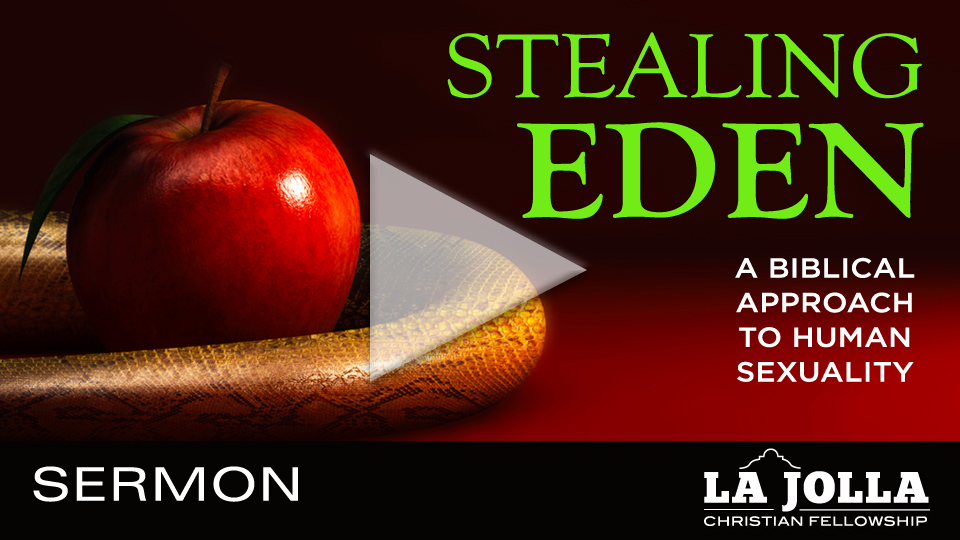
Scripture: Genesis 5:1
Pastor Adam opens a message on sexuality with three short readings rather than one, and the selection is the argument. Genesis 5 on humanity made in God's likeness, male and female, named together. Proverbs 16 on the Lord having made everything for its purpose. Romans 1 on what is plain about God from what has been made.
Purpose is the through-line. The message's claim is that faith-based sexuality stakes its claim at the crossroads of creative sexuality and meaning, which is a different starting point from either permission or prohibition. Marriage, gender and sex are treated as three parts of one design rather than three separate policy questions.
Romans 1 is doing specific work here. The passage argues that what can be known is plain, and that the problem described is suppression rather than absence of information, which is why the message frames the modern disagreement as being about authority rather than about evidence.
The questions put to the congregation are personal rather than positional. What lies have you actually believed about God's plan for sexuality. And, deliberately harder to answer than it sounds, can you define the difference between men and women.
Part of Stealing Eden.
Key topics:
- Purpose as the frame, rather than permission or prohibition
- Marriage, gender and sex as one design rather than three separate questions
- Romans 1 on suppression rather than lack of evidence
Podcast (sermons): Play in new window | Download
Read the Sermon Transcript
Sea Change Church · Stealing Eden · "I Want Your Sex" Pastor Adam Stadtmiller · September 22, 2019
Automated transcript. Not reviewed for accuracy.
Good morning. My name is Chris Bateman, or Bucky, and I, as Drea had said, I get to help out doing some counseling around here and workshops from time to time. And right now I get to read scripture for us. There's three different parts to the scripture reading today. Genesis 5, 1, Proverbs 16, 4, and Romans 1, 18 through 20. Genesis 5, 1 says, When God created mankind, he made them in the likeness of God. He created them male and female and blessed them, and he named them mankind when they were created.
Proverbs 16, 4 says, The Lord has made everything for its purpose. And then Romans 1, 18 says, The wrath of God is being revealed from heaven against all godlessness and wickedness of people who suppress the truth by their wickedness. Since what may be known about God is plain to them, God has made it plain to them. For since the creation of the world, God's invisible qualities, his eternal power and divine nature have been clearly seen, being understood from what has been made so that people are without excuse.
The word of the Lord. Thanks, Chris. Good job. Chris is one of our paid counselors. And if you're looking for some great counseling as a couple's counseling or as a man, talk to Chris, and we're excited to have him be a part of that. We also have free counseling here, pastoral counseling, and scholarships. So we bring in the big guns when we need it. So we can help you out with that. We are in a one-week transitional, it's not a series, but a one-week sermon.
And something I preach about every year, and I teach a, call it a Stealing Eden series, on human sexuality. It's a biblical approach to human sexuality. And yes, the staff asked me not to call it I Want Your Sex, from the 1987 number one hit of George Michael, I Want Your Sex. You're just looking at me, just like first service. But I wanted to call it that anyways, because I think when it comes to sexuality, God wants to speak into that in deep and meaningful ways in our lives.
And we're going to talk a little bit about that today. And then as a church, how do we have this conversation? It's a conversation that we need to have. Before that, I'm going to pray, and then we'll jump into it. Lord God, we just want to thank you for your goodness, for your grace, Lord God, and how you speak to us, and how you love each of us as individuals, and how you want to move us towards you as a Father God.
So I ask that the truth of God's word will be revealed, that the Spirit of God will let me speak in a way that is meaningful to those that are here, and we can each take a practical application on what you want to do. In Jesus' name, amen. Amen. So one of the first things I want to start with is we talk about human sexuality. Obviously, it's a topic that's on the front of most everyone's mind, right? Because there is a huge dialogue going on in culture.
And one of the things that I've realized is that the church doesn't do oftentimes a great job of talking about it. What I see for the most part, what I see or hear is a lack of talking about it. Or when it is spoken about, it's kind of like just this bumper sticker answer. Like, well, God's word said it. I believe that that settles it. And that's what God said. That's never really worked for me personally. When I first got saved, or not saved, but recommitted my life when I was 18 years old to Jesus, I needed a faith that was as radical as what I was experiencing on the street, selling meth and riding my Honda, you know, Hurricane 600 through PB, and Mexico and Indonesia and mushrooms and all that craziness that I was living in.
And it was just nuts. And you know what wasn't going to work for me is the 15-minute pastor's homily with bumper sticker answers. I needed something that had some teeth, if you know what I mean. And so if, you know, Bucky was part of this, we planted, you know, environmentally, we were thinking about the environment in the 80s. And so I think that was kind of, we were kind of early adapters to that as a group of students at Point Loma Nazarene College.
And so the trees you see planted, the palm trees on the way into OB, we planted those as a group. We went to Rosecrans, and we worked with women who were being sex trafficked and prostitutes. And we would go get muffins from a soup plantation and coffee, and we'd bring it to Rosecrans and work with the prostitutes and give them muffins and hot chocolate and talk to them in between, you know, different things that they were doing.
And we tried to bring love to the streets, and it was very powerful. At one point there was a gang war, and all the girls were walking in groups from the different gangs that were out there because different pimps were going by and shooting the girls down at Rosecrans or in different parts of the city. So they would group up, and you'd see these groups of like, you know, from different gangs together because they knew that they wouldn't shoot at their own women.
And so they were clustering, which was interesting. There was an AIDS hospice in North Park, and this is early adapting. 1989, I went up to the AIDS hospice and started dedicating our time. I started painting the walls up there. We had some work days, and I remember there was one transvestite at the time. There wasn't so much transgenderism at the time. But a 6'8 African-American man named Lamar who was just awesome, incredibly funny.
I had a great stereo in my truck. I was really into my stereo. I had a Pathfinder. He brought his CD collection out. We were listening, and he would dance and do these different drag queen things. And so he took me in to show me his outfit. He goes, oh, this is my, I won't do the accent. He had a really cool accent. And he said, this is my Donna Summer number, and it was blue in sequin. It was awesome. Imagine a 6'0, I mean just tall, huge, built African-American man in the Donna Summer's outfit, sequin.
No one thinks that's funny. I thought it was awesome. And he thought it was awesome. And we became friends. He was dying of AIDS. And then he showed me the Aretha Franklin. And so we, you know, at an early point in my Christianity, I realized this is a thing. And this is a thing that we need to figure out. The gay community was terrified at that time, and the church wasn't doing a great job. I went to a Jerry Falwell deal.
My mom took me to it when I was 12 years old. And I remember an activist standing up and screaming at Jerry Falwell down at Golden Hall. And this was my first illustration or first understanding of the relationship between humans and sexuality and faith. Obviously, we are trying to bring faith into that conversation. And the church has to have something to say that is perhaps more provocative than just a few Bible verses that are thrown out there.
First thing I want to say, kind of as we start, is this is a conversation, and it's kind of a toolbox conversation for Christians. It's a toolbox conversation to give you some understanding on why the church believes what it's believed, why it's believed it for a very long time, and what is the meaning behind it. I have one of my daughters was in a conversation with a friend at school, and the friend says, are you a Christian?
My daughter said yes, and maybe as a joke, but the friend says, well, then you must hate gay people. It's interesting how that conversation of human sexuality is so intimately and deeply tied to the faith these days. And it's also a wedge issue to perhaps maybe even try to separate faith from culture, try to minimize faith, and try to show people of faith, whether you're Jewish, whether you're Muslim, or whether you're Christian, that they are perhaps bigoted, perhaps sexist, or whatever it is.
And actually, those are terms I would say that when people use them, I no longer understand what they mean. I know what bigoted meant in the 1980s and the 1990s, but as culture has changed, I find that it's used disingenuously a bit. And so a lot of times I'll say, you know, what do you mean? And because we have a disagreement on a statement doesn't mean that I hate you. We don't immediately move to that place. But why do we believe what we believe?
And I think that as pastors, we need to have these conversations and have difficult conversations. And I think you, as a body of believers, need to be equipped to have a conversation because most people, most Christians I know, really don't know why they believe what they believe other than saying, well, God said it and I believe it and that settles it. You know it's bad when your wife walks out of the series. There she goes.
Off she goes. We only lost two in the first sermon. So if you've got to go, go now. Mark Ronson this week, a DJ, came out as sapiosexual. Did you hear that? It's a new thing. Everybody raise your hand. Everybody hear about what sapiosexual is. That's a new one. It's coming your way, this one. And sapiosexual means that you're, he came out to be, I'm attracted to minds. I'm attracted to intellect. And so it is this new gender that has gone to intellect.
And it's, he talks about that. You can, you can Google that, sapiosexual. Maybe you saw Webster's Dictionary today added the term, this week added they for a use for a singular pronoun for people to say that they are they. And so what we are doing is I believe that we're really living, I find it really confusing. Maybe you don't. And one of the things that people do is they just say, well, I'm not going to be part of the conversation and be very libertarian and not politically libertarian.
And I would say if it wasn't for the taxes and the drugs thing and a couple other things, I probably would be a libertarian because you do what you want, I'm going to do what I want. And that's a very easy way to live your life. And it's the way that we are, I think many, our culture is being called, you know, you be you, I be I, and don't mess with each other. What I am finding, though, is there is an attack against people that hold a rustic or vintage view of the family model or a rustic or biblical view of what God calls for human sexuality.
And this just isn't in regard to, let's say, a, you know, a heterosexual versus some other type of relationship. But it has to do with what does sex mean? What does it mean to be a man? What does it mean to be a woman? Is there any reason? Is there any creative purpose in design? Or let's say you're an evolutionist, atheist. Is there any, is there any place that evolution caused women to be, I'm not an evolutionist, but caused women to be women and men to be men?
And is there something in the design? Now, this is interesting. And I was talking to Eden between the services, and she had a great analogy, and I'm going to use it. She said, I kind of feel that it's all left up to our interpretation these days. It's up to what you feel and a certain person feels. And so she said, it would be like me going to the Louvre in Paris. And there's a Van Gogh up there, and the Van Gogh was awesome.
And next to the Van Gogh is a bunch of, like, markers. And it's like, man, you just, you express that however you want. And you're able to take the markers, and you go up, you know, to, or you go to a different, you go to, like, the Mona Lisa, and you think, she needs a mustache. Or she needs, like, a black eye. Or, you know, some cat ears or something like that. And I'm just going to let, you know, that painting means what I think it should mean.
And I thought that's exactly what I think we see happening in society today. Whether you agree with it or not, I believe that's what's happening in society. And I believe, not only is it confusing for me, it's incredibly confusing for children. And I think it actually destabilizes our identity. I believe that when we move into all these different types of understanding, where now we've just, because the alphabet didn't have enough letters to kind of mix everybody we were trying to include, we've added a plus.
And now if you go and you study this, it's because there are an infinite amount of genders, which is really, really interesting. And so the question is, is in regard to that, and looking at, I believe, which is a sexual chaos. I believe a lot of it, I mean, look, we've had sexual chaos in the culture since the beginning of mankind. This is not new to society. But the question is, what do you believe, and where will you draw a line?
I will say that every single one of us is going to have to draw a line or allow for everything. I think you have to draw a line somewhere. So you say that this is allowable or this is not allowable. And the question is, why do you believe what you believe? I have to say that the reason, I am a person who personally believes that the Bible says that I believe it. But I don't think that works for our culture. So we have to have some more provocative arguments.
And what I do believe in, and what I know works from being in social work, because I am a social worker, for a very long time, is that a family model with a strong, healthy father, and that a family model with a strong, healthy mother, has an incredible ability to build strong, healthy, stable kids. And when you have models that don't have that, while they might have love, and while they can raise amazing kids, and while they can do all that, you have models that are saying that it's okay to have one kid related to only one of the parents, which actually destabilizes the relationship.
It actually destabilizes what I believe that is God's intention. And so what is God intending? God is creating a masterpiece. Human relationships and the models that he created are masterpieces that are created for the best design. And he wants to create a design that we can follow. But that design represents the intent of the author. And so, as a practical toolbox today, that's going to hopefully give you some understanding of what we believe as a church, what Christians and people with vintage and rustic values have believed for a long time, is to give you an ability to have a conversation with people.
And so the first place that we begin is in creation. We believe that God's an incredible artist. And that God created things for a purpose in a meaning. Look at the Romans 1.20 passage. It says the wrath of God, which is a scary statement, is being revealed from heaven against all godlessness and wickedness of people. This is why people struggle with the church, because oftentimes they pull out verses like this, and then they bang them over the head, and we try to scare people into faith.
As opposed to saying there is a loving Father who accepts you as you are. He says, come as you are, but don't stay as you is. And I love you deeply. And instead of bringing the kindness, it is the compassion, the scripture says. It is his kindness that leads us to repentance. We often want to bring out an object of wrath, or something like that, or talk about sin. What we want to talk about is love. And it says that people suppress the truth.
Now, what does that scripture mean? And I've only recently understood what that scripture means. Here's what it means. When God creates something, that thing tells a story. We'll see here in just a moment. When we use it opposite of what it was created for, we begin to tell a different story. Everything you do with your life tells a story. Your commitment to your family tells a story about you, about God. Your commitment to honesty in relationships, all relationships.
Your commitment to integrity. All of these things tell a story. And the reason God has, let's call them rules, or boundaries, for lack of a better word, is so that we can tell a story that glorifies him. This scripture, as I go on, is going to show you that God created the universe to tell a story. He created dads to tell a story. He created moms to tell a story. He created single women and women as a whole, as a collective, to tell a collective story.
He's created all of these things to tell his story. And each piece of this story has a deep meaning. And in that meaning, we find the truth of God. Let me continue reading. It says they suppress the truth. So when you change the meaning, you suppress the truth. Or when you remove meaning, which is what I'm going to argue for today. Since what may be known about God is plain to them. This is basically a common sense. That this is common sense.
That it's plain. That God says, look at how I created it. Look how the design works. If you just look at human sexual relationships. Look at how the design works. This is plain. We can make it more confusing. We can ask a lot of questions. We can look at a bunch of nuanced arguments to try to change the meaning of what is plain. But pretty much, what is plain is plain. And when things are confused, and when things are in a state of chaos, where whatever you say something is, it is based on what you think it is, then what we do is we destabilize a culture.
And so one of the reasons that we believe, the things we believe of rustic, you know, the classic biblical narrative of marriage and family, is because we believe it is the best design to bring the most strength to culture as a society. I want to say that even if I was not a Christian, and it's hard to say what you would do if you weren't something, I would still believe that the primary family model, and the one that I would support, would be one with a mother, with a father, in the family model.
And I'm talking about the family model. And I believe because it brings the most strength to society. It is what the society is built on, and why actually our framers and the government had set it upon a society that builds upon itself. You have to have healthy families to have a healthy society. Now, I am not saying that you cannot have healthy families and other models. What I am saying is that we believe that the Bible shares a story of the healthiest model.
And I come from a broken home where my father was removed from the family, and it was incredibly traumatizing. I'm still healing from it today. I've healed greatly, but that happened, and it was the brokenness of that and not having that in place. And once again, I said healthy father figures, not just having a dad, because just having a dad, you can be a dad but never be a father. And we want to father our children.
Since what is, verse 19, what has been known about God is plain to them. Because God has made it plain to them for since the creation of the world. Now, circle creation, if you would. Because when you are discussing why you believe in biblical, you know, biblical, rustic, vintage values, I don't use the word conservative anymore, I use rustic and vintage values, is you want to begin your narrative, and if you're going to discuss it with somebody, because I think people want to have honest discussions.
I am finding that some of the best discussions, if you can have a good discussion, I'm having some of the best discussions I've ever had. There are people who immediately shout and be upset, and I just don't have time for that. I have a friend that whenever I share points, he's all, every point I share, it's fear-mongering. Oh, you're fear-mongering. You're fear-mongering. You're fear-mongering. Okay, I'm a fear-monger.
You know, every day's Halloween for me. I'm a fear-monger. But he says, since the creation, sign creation. So when you speak to people, say, you can say this, that I believe in creation. I believe in a creative God. And we hang our hat on creation. And we believe that creation has a purpose. And creation tells a story. And the design of human beings tell a story as we see God in creation. And as you see this, it inspires us.
For since the creation of the world, God's invisible qualities, his eternal power, his divine nature, have been clearly seen, being understood from what has been made so that people are without excuse. You know, I've really moved in my discussions with people. Because, look, this is a really primary discussion in our culture right now, especially in schools. Obviously, the sexual education, these kids know right here, if they're in public school, you have to be, you know, your parents can opt out of it.
There's some fine print when you sign your kids in. But you can opt out of it. But every year, from sixth grade to their senior year, they are getting, is it two weeks or one, of training in middle school? They had a two-week thing my daughter recorded and my daughter lived. Maybe it's just in middle school. Is it not in high school? Maybe it's just in middle school. But for three years, look, that's what you have when you have editors here.
But she recorded two hours, you know, of recordings of what was happening. So obviously, there was a narrative going. And I believe that the faith community has to be able to speak into that narrative. And I said, each of us is going to have to draw a line of where that is. I believe that that line is moving quickly. I don't want to be a fear monger. This is one of my fear mongering ones. So you can chalk this one up to fear mongering.
But I do believe that within 10 years, or less, you're going to see a push towards pedophilia. I believe you're going to see a push to have children be able to make their own decisions to be able to have sexual relationships with adults. Now, you had this in Rome. It's happened in our society before. But why are we not for that? And what I'm understanding is because children are allowed now to choose your gender, which is, you're seeing gender reassignment surgeries as easily as four years old, which, you know, eight years old, you can look those things up, that I believe that there will be a push to continue to push that line.
And so for me, I find that this is, maybe it is fear, because that kind of scares me a little bit. But there will be a push, and every one of us will have to draw a line somewhere. And we're going to have to draw a line based on something. Where I have chosen, and where I think we as believers have chosen, is to realize that God has creation, that creation tells a story, and what does it tell about that story? We want to have fathers that are healthy and healthy family.
Looking on, one of the questions I regularly ask my friend is this, and I believe that if there's one thing that's happening in society today, meaning is being removed from sexuality. Not only does it mean what you think, whatever you want it to mean, but it can mean whatever you hope or decide that it means. And so for instance, the meaning of marriage has been removed for now it has moved to any group of people who love each other can be in a marriage.
Now I believe you can be in a community group, I believe you can raise children, but I would not call that marriage. I would call that a family, or a group, I wouldn't even call, I wouldn't call it a family group, I would call it a group that is decided. I actually have a friend group right now. They have three parents, and they're all together. There was a parent group, two parents that were together, one cheated, and then they decided they were going to stay together, and the third person moved in, and now all three of them are raising the child together.
This is a family model that is seen as one of the options. I couldn't personally do that narrative myself, but it is allowed, and we're seeing that love is supreme. One of the things you know about love, and one of the arguments, is we believe that God is love, but love is not God. And so what happens in society, and what the enemy always wants to do, you see this in Genesis, is to truth up a lie. And so you take a lie, and you find the truth in it, and the best bits, it's classic, Genesis, early Genesis, and you truth it up.
So if love is supreme, then whatever is done in love is okay. Well, I believe that's true to a point, but love also has boundaries, and we will find those boundaries in love, even if you draw them in different places. Perhaps you saw Demi Moore. Remember Demi Moore? She was in Ghost, the movie. And she was talking this week, she has a new book coming out, so she's telling about her memoir, and she was talking about her relationship with Aston Kutcher, who at one point, had the most Twitter followers of anybody.
Now, no one even remembers. You know who Aston Kutcher is, kids? You do? No. Raise your hand if you know who Aston Kutcher is. Two. Okay, great. So, that shows you how much important it is to be the number one Twitter person at one point. So, he's talking about a relationship, and supposedly, their marriage broke up because he cheated on her. Now, he said that he had, his understanding was that he had an open relationship, and that was the boundaries.
Well, what she went on to say is that she decided it would be cool to invite somebody into their relationship with them, so the three of them would have these sexual encounters, but that was cool because it was in the rules. But then he broke the rules, but he decided that, you know, it was an open marriage because of that. All that to say is that there is rules, and even love, if you were going to use that example, as something that's allowable, an open marriage, you're going to say it's allowable, which if you're in the world, fine.
God has this amazing way to let the world be the world. I don't get angry about what the world is doing unless the world is trying to do it to me, or trying to challenge my belief, or to change me, or to try to ostracize us on what is based on truth. And so we find these rules, and one of the things we believe about love is love has boundaries, and love has commitment. And oftentimes, you talk about love, what does love, would you rather be in a relationship that is known for its love?
Granted, I'm parsing this apart. But would you rather be one that's known for its love and the feeling of love, or would you rather be in a relationship that is based on commitment, and has commitment based on love? Because I say feelings, you know, when it comes to being in love, I don't really know what that means. I know what it felt like when I met my wife. I was like, darn, yeah, that works. I know those feelings, but I know when those feelings don't happen, and there comes a point where we're committed.
Why do we believe in covenant relationship and marriage? Why do we not believe in open marriage? Because God has shown, and he didn't have to do this, that he created something to covenant, to say that you can trust me, and I am with you. And so why do we push so hard for the covenant marriage, and marriage throwing the story of commitment? Because God made a commitment to us. He created marriage. He could have created marriage as an open marriage.
You know that. If God wanted to, he could have created marriage to say, you can marry 50 people, 80 people. We see that in the Old Testament. It was never shown in the Old Testament. It's God's plan. He never okayed it. They did do it, but it was never okayed in the Old Testament. It is meant to mean that you can trust me. This story of commitment tells that you can trust me, that I love you, and I'm not going anywhere.
I wish to goodness, my dad would have had that commitment. You know? And I wish, you know, I remember I started, it was about five years ago when I started, I remember eight, ten years ago. One day I just started crying, and I thought, Dad, why the heck were we not worth fighting for? Why did you give it up? And I understand. Every story is different. I understand that there are messes, and I get it. Look, I've been doing this a very long time.
There's not a story I haven't met, and there are times where people need to be a part, and they need to say, no, enough's enough. I won't accept that any longer. We are setting boundaries, and God sets those boundaries in the Old Testament as well, in the marriage covenant that he talks about. But marriage is about commitment. Why do we believe in marriage, which is actually going out of vogue? Why do we believe in it?
Because we believe in commitment, and it tells the story of God. Continuing on, one of the things that I ask my regular friends is, and today, is this meaning, and finding meaning. It's a great question. If you're ever having a conversation with somebody who is at an extreme point of view in regard to sexual freedom, or, you know, the transgender issue, which is a powerful issue, one that I've dealt with personally, not personally myself, but with people, is I tend to ask my, I ask my friend this question.
What is a woman? It's just a great question. It will pretty much end the conversation. I just ask, what is a woman? Well, because he's extreme, he's not liberal, he's leftist, and we're friends, and it's the next degree over, and he won't ever identify any physical characteristic with a woman. So you have to remove the biology, and there is a push, just read the news, I'm not telling you, am I telling anybody anything they don't know?
I hope not. That there is a push to remove the biological meaning. So the design has nothing to do, being a woman has nothing to do with your biology. So he would never say that it's, you know, you can have, you can form an egg, or you can have a baby, because then you have these questions, what about women who can't do that? Are they not women? So there's all these different questions. So the first thing is, okay, we're not going to tie it to that.
I say, okay, fair enough, we're not going to tie it to that. Well, then tell me what a, give me a characteristic of a woman. Can't do it. Why can't I do it? Because it would be a negative gender, correct, negative gender stereotype. So there is no meaning meaning to being a woman. This is one of the reasons that feminists are having an incredibly difficult time at the moment, because there is no ability to attach anything, meaning.
This is one of the points that I want to share with you that I think really is where I hang my hat. I believe that sexuality and gender has meaning. It has a meaning, and it has a meaning beyond what you think it means. And I believe that that meaning is clear. A lot of the conversations I have these days, I don't go into all the minutia, I just say it's obvious, because it's clear, because the more I talk, the more rabbit holes we go down, the more questions, I just tend to say oftentimes, it is clear to me, I've seen it over and over again, what works.
So what is a man? What is a woman? And do they have meaning? And do they have purpose? I believe that women were created for a purpose in society. Now I believe that they have a collective purpose, that women are free to do anything they want. We are in one of the most forward-moving, would be a good way to say it, women, in regard to women's rights, since the 1800s, the Baptist, this church is an American Baptist church, has been fighting for the rights of women and women's suffrage, and have allowed women to be pastors and lead elders since the 1800s.
We have had a lead elder who was a female, women can be pastors at this church, we believe that God liberated women from the curse that they were under, that's a different sermon, which I did in this series, but we believe in the freedom of women and we believe that women bring something to the table and that women can be identified by characteristics. Now, the Bible, which is so interesting, the Bible doesn't actually have a bunch of verses that say, well, women does this and a man does this and a woman does this, but it refers to a lot of things.
If you read the Song of Solomon, it shows a gentility in women. Would you, you know, 57% of people in the recent 2017 Gallup poll said that they believed that there were strong characteristic differences between men and women that can be defined. Back in 2001, there was a Pew research poll asked if women were more gentle than men. 91% of people in 2001, that's like 12,000 years ago, by the way, in regard to this topic, said yes.
If you just want to look at characteristics, I'm not sure that facts matter as much anymore because we are moving away from facts that, if they don't affirm what you believe, we move away from those. The Bible is based in absolute truth and it is one of the dividing lines. There are things we believe and we believe that that truth gives a structure for that. By the way, this is not easy. You guys, anybody want to take over for me midway?
Okay, right. Yeah, right. I was like broke a sweat in the first sermon. That we believe, that I do believe, that, you know, the Bible doesn't say women, I made women to be more nurturing. Are women more nurturing than men? Can I see that? Absolutely. I mean, I just see it. Now, that's, the Bible doesn't say that. The Bible talks about a lot of nurturing qualities of women. Do I believe that women bring, like, an emotional understanding and intelligence?
Yes. Do I believe that women live closer to their heart? Yes. One of the problems, because they actually, there's another study that said that, like, 93% of people believe that women are more emotional. This has become a negative thing. Whether you believe they are or they not, only because of the age of enlightenment and reason have we, you know, diminished emotional intelligence. I believe that most women, I have found over and over again, live closer to their heart.
And a lot of the emotions flow from the heart. And in that, you see a powerful strength. That doesn't mean it's a bad thing. It doesn't mean that women are, oh, they're just emotional. And, you know, like, you hear that. That is negative. But do I believe that God brought women to bring an emotional sensibility and a nurturing to our society? Yes. And can it be proven? Yeah. You know what? 90, I think it's like 90% of murders are committed by men.
A lot of that has to do with war. There's not a country in the world right now where women commit more murders in that country than men. Men are more aggressive than women. It is true. The statistics back it up. There is a difference. All that to say, what is God saying in the story? And if we remove meaning from the story, we remove the story of God, we remove the gospel. And what do we believe? And are we going to stand on what we believe?
I've got to tell you, it would be a lot easier for me to get up here and do sermons on prosperity for you. On that God loves you. He's going to give you whatever you want. Come as you are and stay as you is. And there's really no line. And you can grow a church because people want their ears to be tickled. But I do believe that there's a truth. And I believe in kids. And I believe in children. And I believe in families.
And I'm not besmirching family models. There are other types of family models that raise great kids that love their kids deeply. And I'm not saying that that's wrong. Okay? I'm not saying that that can't be, God can't use that. But we want to do and what we are called to do is figure out what God's design is and to find that as ultimate truth and push that design and to continue to live into that design because it tells a story.
So we find now that we're erasing marriage. We're erasing gender. We're finding that, you know, obviously the gender has no meaning. And if gender has no meaning, one of the questions I ask my leftist friend, and he is leftist because there's a difference. I mean, he's not wearing a mask and coming to the house and breaking the house down. But he's pretty leftist. And one of the, one of the, you know, questions I ask him, well, if there is no, if there is no meaning, like there are no characteristics that define it other than a feeling, what is that feeling?
Because I asked my daughter Lucy this week, I asked her this, and she says, well, it's not biological anymore. She's a big thinker. And she goes, it's not characteristic. So I said to her, well, then what is it? What does it mean to be a woman? And she goes, well, it's, they're going to, they, she said, I don't know who they are. She says, they're going to tell you it's about your feelings. And I said, well, what does it feel like?
It's just feelings. But I said, but what does it feel like? Well, I can't, we, we, they won't define those feelings, but they'll tell you that it's based on your feeling. But so we can't tell you what it feels like to be a woman. And so my question, I asked my leftist friend, is if you are going to agree with a, with a transgender understanding of sexuality, what are they identifying with? There's actually no reason to transition because you're not transitioning to anything.
What exactly are you identifying with if everything, the meaning of everything has been erased? I just don't get it. Why not just be you and just say, I'm a woman? Why is there any reason to have a reassignment surgery if it's not biology? Why, there's just no reason because once away we've, we've, we've meant it. But I, here's the thing. There is a reason and they can see the people can see the reason and they want to identify with the reason because God says in the scripture in Romans 1 20 that it's clearly seen.
And so you deny the truth, you suppress the truth, but you still see it. And so you identify and you move towards those things. What we want to do is try to help inform what it means to be a godly man and a godly woman. Now that doesn't mean we're going to say, hey, we're having steak dinner for all the men. Hey, we're macho. Get strong, talk with an awesome accent, you know, like this, talk like from Australia, you know, really, I got some Australian friends here.
Like you live in the outback. We're not, we're not stereotyping people into roles. But what does it mean when Proverbs 31 says that there is a godly woman and this is what they look like? By the way, that godly woman is awesome. If you read about her, she's selling land, she's got a family, she's getting up in the morning, she's tearing cloth, I mean, she's just gnarly. She's doing everything but cage fighting. She's so awesome.
Women are awesome. I surround, I personally surround myself with powerful women. If you, not on purpose, but, but when they are here, I want someone that can do the job. Chris Harrell, you're gnarly, you're pretty awesome. Drea, you know, my mom, this is the example that I came with. Strong, powerful women and we want them here but I want them to lead, I want them to have, have charge and go forward but I also want them to represent and they can tell me what it means to be a woman of God and it talks a little bit about what does it mean to be a man of God and it is nuanced.
There isn't just one definition. You have, people are different and God makes them different so we're not going to hang our hat on anything but we do believe that there is a collective and I will personally say that I believe that the ability for an emotional intelligence living closer to the heart which is where we believe, you're not saved by your mind although mind helps, it says, where do you have to believe? Believe in your heart, the scripture says and new studies have shown that your, that there are brain neurons the same type in your heart and your heart can think in the same way that your brain can think and there actually might be more and this is why sometimes when they put people's hearts into different bodies on heart transplants they have memories of the other person.
So just because you live closer to your heart or you might be more emotive out of your heart doesn't mean that you can't think. Actually the scripture in my opinion, Jim and I argue about this on occasion, but in my opinion I believe that the way the heart thinks, the way the heart goes is actually the main compass. The mind helps direct us but I believe it's from the heart that we are saved and God puts salvation based in the heart.
So go women, that's what I'm saying. Let me just finish and come in for a landing as we talk about this. The tool is this. We believe in a creative God. You might not but as a church we believe in a creative God and God has a purpose for everything that he has created. And when you speak to people say I believe in God, I believe in creation and out of that creation I believe that creation tells the story of who God is.
And I believe that he has truths that he wants to reveal. Could he have done it differently? Absolutely. Could God have done it in many other ways and allowed many other forms he did but that isn't the story he told. He told this story. Let me tell you what I understand about covenant. Let me tell you what I understand about commitment. Let me tell you about nurturing. Let me tell you what I understand about all these different aspects of relationship.
It's complimentary as we move. So as moving down, I'm going to jump over. I'm going to actually move down your notes because I've run out of time a little bit but I want to talk about where we go as a church. Because we actually have to start getting things right. the amount of pornography in the church is rampant. It's rampant in the world. Since, I mean, actually the whole change of our thoughts on human sexuality and you look at the spike and the change, it actually goes along with the phone.
It's not just social media. It's the ability. You look in India. I was talking to some friends from India about the rise in the rape culture and all the things that are happening there that have to go with just what you're exposed to. If you're exposing yourself to these things, it actually demeans people. I believe it's impossible to look at pornography without being part of the entire chain, pornographic chain which goes all the way to child sex trafficking because all those clicks pay for the system and the chain.
All that. So when we're involved in today, you might think, well, I'm just looking at something that woman wanted to be or that man, they wanted to put that video up so I can watch that video. They did what they did. I do what I do. There's no difference and that's just a solitary event. That's not true. That whole industry is tied together and one of the strongest reasons if you have an addiction problem with pornography and our podcast this week with Chris Bateman and Harry and I are going to talk about addiction, not just sex addiction this week, is to realize that it affects everybody and it affects that whole link down all the way to Thailand and kids that are coming across this border but we have to get back and get back to purity.
We have to have a church and we have given away purity. We have given away not having sex before marriage. I actually have a lot of young believers coming. I had one who I really respect. He's all, how can you so firmly believe in abstinence before marriage? How can you believe that so strongly? He's like, you just say it. You just say it. For me, I'm like, when I grew up, that was basic Christianity 101. One, I know that it shows my partner if I'm willing to wait for you, I'm also willing not to run off from you.
Like to show my wife, like hey, I'm willing to wait. One of the things it does is it shows a commitment and a trust and a willingness before you give me all of you, the final seal of the marriage, I'm willing to show that I'm here for more reasons. I remember, I got married, we, on our honeymoon, we stayed here in La Jolla, actually on Draper Street, which is really interesting. And I remember, I went down to the beach and I had this thought that kind of terrified me.
It hit me and I realized it would have hit me differently the day after our honeymoon. And the thought was this, that my wife can know that I didn't marry her for physicality. That there was nothing that was confusing why I married her. I married her for who she was as a person and then the sexuality came second. Now I know personally that, and look, I had a pretty raucous past before I was 19. I went eight years and didn't have sex from the time I was 19 until I got married.
And then three years before I were in dating relationships, I didn't kiss or anything. I just held hands for three years just because I thought I just need to get this right. That's just the model that I needed to do. And I'm proud to tell my kids that when they ask, hey, did you sleep with mom? The question, the answer is no, I didn't. And if you did, there's grace to all that, but I'm just saying where it is. And I'm speaking to people who still have not been in that situation.
But I was sitting there and I could tell my wife and she knew that I chose her for no other reason than who she was. And to have that, that, you know, to have the intimacy that comes on the, you know, the night where you have a honeymoon or after your wedding to just solidify that changes everything. I actually don't know. I'll never know. But I wonder sometimes through all the difficulty we've gone through, through ups and downs and early on yelling and the different things that went on in our relationship if we would still be together if we hadn't made that decision.
I don't know. I just feel that it added something. And I feel like as a church, I just think it's something we need to reclaim. We just need to reclaim purity as a church, not only in what we look at. I told in the first sermon, it was kind of funny. But one of the things we have to watch what's coming into our, you know, through our eyes, the stuff we watch on Netflix. I mean, you know, to God, I think whether, whether, you know, I said, if you go to look in somebody's window when they're changing, it's no different than watching Netflix except you're going to get arrested.
it is different. Okay. It's a big difference. It's a big difference. But before God, I mean, I don't have a right to look at, whether you allow me to look at it or not. This is one of the things with modesty to, to like, you know what? This is special. When we remove meaning from the body, the human body, nothing is special anymore. To say that I have somebody that I'm waiting for and this is special and no one else is going to see it and I'm going to have a committed relationship and for me, I had given all that away when I was 19, but when I was 19, I said, line in the sand.
Line in the sand. And then I made another line in the sand when I was about 25. I got challenged. I said, you be single for a year and ended up being two. And I said, I'm going to make a line in the sand and I, and you know, it was hard. And it was, it took commitment, but it was that commitment and watching the commitment of other people in my life and other men in my life and knowing about the loss of commitment that I had in my own family.
Not only did my dad leave, my stepdad left after that. So it was like a double, you know, whack in the face. You know, for me, I've just, for my own history, I thought not on my watch. Just not on my watch. And my wife's the same way. and so for us, if we can't work it out, then we separate until we can. That's our deal. Now that's not a biblical thing. That doesn't say, that's an Adam thing, okay? Paul talks about this regularly.
But she, when she moved out for a while, 15 years ago, said, I love you, but I can't live with you anymore because you're a royal pain, basically. She said, I want you to know I'm not going to go find anybody else. I'm not going to go get in shape, go to the gym. You know, you always see people, they always start gyming up, you know what I mean? They lose like 30 pounds as soon as they break up, you know? I'm not going to go gym up.
I'm going to go sit and wait and work our stuff out. And so we, one of our counselors, Corrine, who was on our staff here, was the gal that saved our marriage. And it was really hard when your wife gets that dead look in her face. And if you've seen it, husbands get it too. I see it more on women than men. And maybe you know what I'm talking about. There's this look and when they come in for counseling and I see it, man, it's hard to come back from that.
It is a dead look and there is no emotion anymore. And it's like, I have removed my heart from you because it's no longer safe. And my wife had that look in her face and she doesn't have it anymore. Thank God. Now she kind of smiles when I walk into the house. It's awesome. Here's the deal. I'm, I'm, I'm, I'm landing. It's, you know, I've gone, I've gone too long. Here's the deal. I'm not making a bunch of definitive statements trying to say you have to be this, being your parent, being your dad.
What do we want as a church? And do we believe that this model that God has given us creates a strong model that people will look at our churches, that will look at our families, that will look at our marriages and say, wow, you know, I don't believe what they believe, but how are they doing that? How are they doing that? I really want us to be a divorce free church. I want us to be a church that can work things out.
I don't want kids that, you don't want kids to have to go through that. Sometimes you need separation. I'm not saying you don't know. Everything I've said has 10,000 questions. I get it. But what I am saying is I want us to set a different standard. You have to go before the Lord and say, what do you want? And is this what you want as a church? Is this the kind of organization you want to be involved in? There's a lot more to talk about, how we relate to the world.
But like Paul said, I don't judge the world. That's the world. But we do have something to say about the church. Amen? Let's stand. What I want to do is just bless you as we go and as we close this service. Chris is going to lead us just quickly in just a place to get our heart right. And if something touched your heart today and you're like, wow, I need to recalibrate, it's time to recalibrate. I need to rethink. I need to change.
I, you know, I'm going to believe in faith or I need to, you know, just talk to God about this or just take time to think. Say, I'm not sure I agree with all that yet. Hey, by the way, that was a download, FYI. You know, your eyes are probably peeled back from, you know. But to talk about this and take it, what does God want to say through your identity? What does God want to say through your sexuality? What does God want to say through your family?
Your lack of a family? Through your singleness? What does God want to say? What does God want to say in love? Chris, lead us. Jesus, you are enough. Jesus, you are enough for me. So here we want to give you a place. There's a whole bunch of things that are coming up where you can go deeper, where you can get connected, where you can get healed. And if you need help in a marriage, you need help with raising your kids, we have Chris's parenting toolbox coming up.
We want to be a place full of resources for your heart. If you're healing from grief, if you're healing from a divorce, if you're getting remarried, we want to give you counseling to help with that. Whatever you need, but to get our heart. This is a place of resource. But more than anything, it's to resource the love of God. We want to see everyone know the truth of God's love and His salvation. If you extend your hand, I want to bless you now before we gather to eat.
Lord Jesus, I bless this group of people, God, with the love of God, the hope of God, and a hope that says, if you follow me, if you bend your knee to me, I will be a father to you. I will come and I will love you. I will call you near. Song of Solomon says, I'll call you near with intimacy. You are mine, and I am yours, and I'm not going for anybody else. It's just you. God has you in His sights. He has you in His mind.
He has you in His heart. It's just you, and He will never forsake you and never leave you. Just turn your face to Him. And if that's you, and you just need that, with all the heads bowed, eyes closed, you just need that. Say, I need to come back to God, or I need to just check it out. God, just raise your hand. I just want to see your hand. Just say, I need that. Yeah, yeah, right on. Yeah, right on. So I bless those, God, that said that.
Resource your love. God says He loves you deeply. In the midst of confusion, in the midst of this world and the fear, God says He loves you. We bless you with His love. We send you out of here today with the love and nurture of God. In the name of the Father, Son, and the Holy Spirit. Amen.