
JUL 21 2019 | Shame of Thrones: The Story of David & Bathsheba S1E6 | Truth & Consequences
JUL 21 2019 | Shame of Thrones: The Story of David & Bathsheba S1E6 | Truth & Consequences
Book: 2 Samuel
Scripture: 2 Samuel 12:11-25
Forgiveness arrives and consequences arrive with it. Nathan tells David the Lord has taken away his sin and that the child will die, and 2 Samuel 12 spends the rest of the chapter on what a man does inside that.
Pastor Adam gives four instructions, and they are unusually hard-edged. Truly repent, leaving no margin for a plan B, since repentance that keeps an option open is negotiation. Face the music, taking personal responsibility rather than distributing it. Worship the Lord, which the message calls the place where fear of consequence dissolves. And move on, letting the present define the past rather than the past define the present.
The passage supports the third one in a way that surprises most readers. While the child is alive David fasts and lies on the ground; when the child dies he gets up, washes, and goes to worship. His servants find this incomprehensible, and his explanation is the message's key line about God not being in bondage to the temporal.
What the chapter refuses is any suggestion that forgiveness cancels consequence, or that consequence proves forgiveness was withheld. Both are true at once, which is harder to hold than either alone.
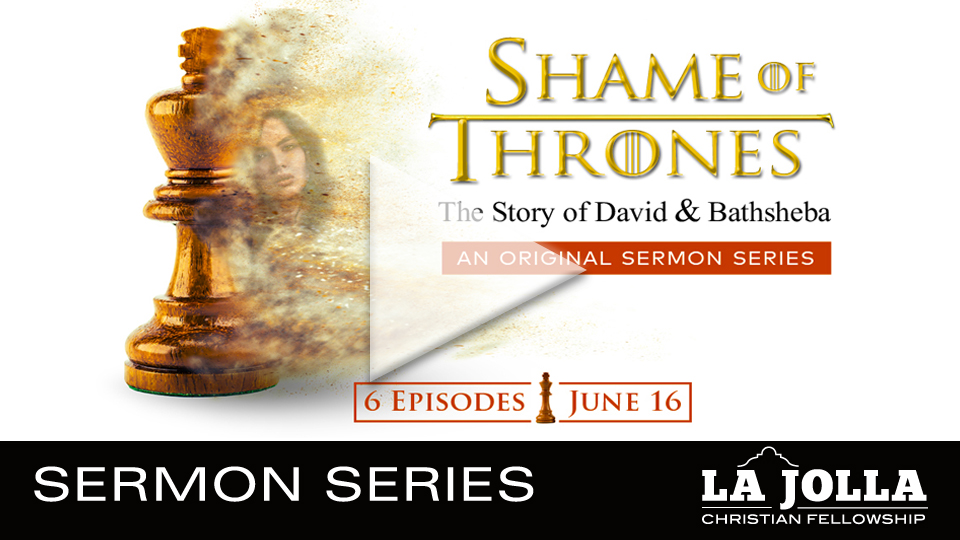
This is the sixth message in Shame of Thrones: The Story of David & Bathsheba.
Key topics:
- Repentance with no margin for a plan B
- Getting up to worship after the worst news, and God not bound by the temporal
- Forgiveness and consequence both true at once
Podcast (sermons): Play in new window | Download
Read the Sermon Transcript
Sea Change Church · Shame of Thrones: The Story of David & Bathsheba · "Truth & Consequences" Pastor Adam Stadtmiller · July 21, 2019
Automated transcript. Not reviewed for accuracy.
Amen. My name's Harry. I'm the Student Ministries Pastor on staff, and I'm reading our scripture today. The scripture reading comes from 2 Samuel, chapter 12, verses 11 through 25. This is what the Lord says. Out of your own household, I'm going to bring calamity on you. Before your very eyes, I will take your wives and give them to one who is close to you, and he will sleep with your wives in broad daylight. You did it in secret, but I will do this thing in broad daylight before all Israel.
Then David said to Nathan, I have sinned against the Lord. Nathan replied, The Lord has taken away your sin. You are not going to die. But because by doing this you have shown utter contempt for the Lord, the son born to you will die. After Nathan had gone home, the Lord struck the child that Uriah's wife had born to David, and he became ill. David pleaded with God for the child. He fasted and spent the nights lying in sackcloth on the ground.
The elders of his household stood beside him to get him up from the ground, but he refused, and he would not eat any food with them. On the seventh day, the child died. David's attendants were afraid to tell him that the child was dead, for they thought, while the child was still living, he wouldn't listen to us when we spoke to him. How can we now tell him the child is dead? He may do something desperate. David noticed that his attendants were whispering among themselves, and he realized the child was dead.
Is the child dead, he asked? Yes, they replied, he is dead. Then David got up from the ground. After he had washed, put on lotions, and changed his clothes, he went into the house of the Lord and worshipped. Then he went into his own house, and at the request, they served him food, and he ate. His attendants asked him, Why are you acting this way? While the child was alive, you fasted and wept, but now that the child is dead, you get up and eat?
He answered, While the child was still alive, I fasted and wept. I thought, who knows, the Lord may be gracious to me and let the child live. But now that he is dead, why should I go on fasting? Can I bring him back again? I will go to him, but he will not return to me. Then David comforted his wife Bathsheba, and he went to her and made love to her. She gave birth to a son, and they named him Solomon. The Lord loved him, and because the Lord loved him, he sent the word through Nathan, the prophet, to name him Jedidiah.
The word of the Lord. Solid. Thank you, Pastor Harry. Yeah. Phenomenal. I mean, not as good as Bonnie, but solid. Really solid. Yeah, he's trying. He's trying. That's the invitation challenge matrix right there that we live in. Hey, good to have you this morning. Welcome to the final episode of the David Shame of Thrones series. And we're going to be looking at the consequences. Last week, we looked at forgiveness and repentance.
And how to grow in repentance. And it's something we don't often think about as believers, of how to become mature in the way that we repent. When David repented, one of the things that we learned is that he meant it. And when he did, he never committed the same sin twice. Granted, there was disobedience. But when he repented, he repented fully. And God took him at his word. And this is why God ushered in such a great redemption because of his sin.
And what is really interesting to see is that within moments of David kind of finishing up with God. Because there was an eternal consequence that God was taking care of. But there was a temporal consequence that was still going to be played out. And one of the things that we see is God takes care of the eternal consequence with David. In regard to forgiving him of his sin and saying that you will not die. But the temporal consequences are still going to be worked out.
And he immediately goes. And he goes and comforts his wife. And what is so interesting is God immediately redeems that sin. Now, there's a lot that needs to be worked out. But the son that comes from the comforting of his wife is Solomon. And Jesus comes to the line of Solomon. That there is an immediate redemptive work. And there was also, as we saw last week, an immediacy of forgiveness. God didn't wait around and, you know, pout for three weeks when David said he was sorry.
And then come back and give David the silent treatment. He went and it says that he was immediately forgiven. And this is powerful as we look at David. And learning how to take the worst, lowest moments of your life. And to find redemption in them. Because as we look at consequence today. One of the things that I think we need to understand when dealing with consequences. Is that God takes consequences. And he loves, is the redeemer of consequences.
The Bible says that whenever there is a consequence in Romans. That God will cause every consequence. All things it says. But that includes consequences. All consequences to work in your favor. He will cause all things to work for good. That those that love God and are called according to his purposes. And so we often times as human beings want to run from consequences. We want to run from the results of our actions.
We want forgiveness. And then we want the erasure of our, or the erasing of all of our consequences. To find out that's actually not biblical. God has removed the eternal consequence from us. But he often allows the temporal consequences. So that we can grow in maturity and be more like him. We're going to see that in a moment. But God does redeem the consequences that you have. And the first thing I want to say before we go into the notes is that probably one of the greatest things that you can do in order to have personal freedom is to take personal responsibility for your actions.
And accept and face the consequences of those actions. Let me say one, let me say it again. One of the most freeing things that you can do is to take personal responsibility for your actions. Whether those are good or whether those are negative. You don't always have to take responsibility for negative actions. Some of your actions are awesome. Take personal responsibility and then have the courage to stand up for the consequences and accept the consequences.
One of the things you'll see, not only in scripture or our relationship with God or our relationship with others or in your own personal walk to gain healing, is that healing and redemption doesn't begin until you actually take personal responsibility for those actions. I mentioned last week that one of the things I'm trying to get better at not doing, and I think I've gotten much better at it, is, you know, if my wife has something that she's correct about and we get in a disagreement and she brings something up to me.
She's actually here in this service. There you are, babe. So I've got to be honest. That when she does something, I try not to spend three or four days defending something when I know she's right. I don't know if you're good at that. But I'm phenomenal at being, you know, kind of just a little bit slippery when, you know, we're in a discussion. Because I don't want to be wrong, right? Even when I know I'm wrong. And so I had these phenomenal tools to argue, to reason, to do all these different things, to show that I was right when I actually knew I was wrong.
I have to say that that is some of the most emotionally taxing calisthenics that you can do. Not only that, I don't have the emotional margin or personal desire anymore to run in that race. What I'd rather do is, because I love peace, I love redemption, and I love seeing God work things out, is I love standing up to a consequence and then just facing the consequence. Not that I love it. But when I move into it, I realize that that is redemption comes.
And this is part of my own personal maturity, is learning how to stand up to consequence. David does this. I want to say one of the things that you're going to find really interesting, if you're in a conversation with somebody, and let's say you've wronged somebody, and they come up to you and they say you're wrong, and you know you're wrong, right? Whether it be a boss, a wife, husband, kid, whatever. Especially when your kids approach you and they say you're wrong and you know.
Like, that's always hard, right? Like, your nine-year-old comes up to you and goes, Dad, why did you do that, you know? I just say, if you want to let someone look like a deer in the headlights, try this one on for size. And it has to be authentic. Say, you know what? You're right. I was wrong. I realized that my actions were incorrect. I want to take responsibility for whatever the consequences are for those, and I want to ask your forgiveness.
But I understand that you can be upset, and whatever you think is the proper consequence, I'm more than willing to face it. Try that one. People will be, they'll be like in a room with no doors. If you're in a discussion, because people are so used to either having a victim card thrown out, or it isn't my fault. This is Adam and Eve in the very beginning. Why did you do this? Well, she made me do it. Well, he made me do it.
Hey, you know, then Adam blames it on God. You know, that woman you gave me, what's up, you know? But blaming it on everybody. One of the, I think, the strategies of the enemy in our culture is to create a victim mentality. Obviously, victimization happens, but you can be victimized and not live as a victim. We've said that many times. Jesus was victimized, but he never lived as a victim. But if you're a victim and you live as a victim, you never have to take personal responsibility.
And if you have a culture that never takes personal responsibility, then you never take personal responsibility for your sin. When you don't take personal responsibility for your sin, you can't repent. When you don't repent, you end up eventually having to take personal responsibility for your sin when it's too late. So that is one of the reasons that if you were the enemy, you would want to create and sew that into culture.
David never did that. David, when he knew he was wrong, he admitted that he was wrong and he was willing to face the consequences. And if you want to be free, one of the best ways to be free, it is so freeing to accept that you're wrong. It really is. It is much freer than trying to argue that you're not, especially with God in these situations. And one of the things we're going to look at now is the matrix of forgiveness and consequence.
Because we see that God is dealing in the eternal. And he understands that there's a temporal. But he forgives David in the eternal. But he still allows the consequences to be worked out. Now the question is why? Why doesn't God just say, I forgive you, everything is forgiven? We'll look at that here in a second. But I want to just look at this immediate forgiveness before we move on to that. Immediate forgiveness, as you'll see in your notes.
He says, the Lord has put away your sin. God's forgiveness was immediate. Now why is that? Why did David not have to face the penalty of the law? Now it says right here in the notes that God did not demand a time of probation. You shall not die. It meant that David would be spared the penalty of adultery commanded under the law of Moses. And that penalty was death. Now, why was it death? Because the law was meant to show the visible law and the consequences of the law on earth were meant to show the invisible reality that is true for heaven.
So when you sin, certain sins, there was a death penalty to it. In the same way that when we sin before God, eventually we will face eternal death. And so the reason that there was a law was to show this archetype. Now Jesus comes and he pays the consequence of the law on the cross. The reason God can say to David and still be just, you do not have to pay these consequences is because of Jesus' death on the cross. Now how can that be?
Jesus hasn't died on the cross yet. If you read Hebrews 11, it's going to tell you why. Because when Jesus, imagine when Jesus is on the cross and he has two arms extended, one is reaching back. And on this arm, it says faith of what is to come. And on this, it says faith of what has happened on the other arm. Imagine that tattooed on Jesus' arms as he reaches. The Bible in Hebrews 11 says, if you believe in faith of what is to come, which Abraham, he believed that Messiah was coming, then you were saved by that same faith as that you and I are saved by or anyone else who is here after Jesus died on the cross, if that makes sense.
Faith is the bridge. Abraham and David believed in the faith of what was to come. We believe in what has come. And that is why Jesus can take this, or excuse me, God can take this penalty for David and choose to not cause him to face that penalty of death. But at the same time, God doesn't remove the consequences. And why is that as we look at it? I'm going to look at your notes, extended consequences of sin. One of the things you're going to see is that sin has consequence, right?
And sometimes it takes years upon years to work out the consequences of a generational sin in a family. Whether it be alcohol, abuse, or whatever that would be, these things take time. In the notes, it says God has saved us from eternal consequence, but not from all the temporal consequences. Now, why is this? Why doesn't God just, hey, I forgave you, so everything's okay? Imagine the father. I've been listening to a lot of country music lately, okay?
I've been listening to Waylon Jennings, Hank Williams. Just started listening. It kind of accidentally played on my Spotify, and I'm like, I think I'm going to listen to some Waylon Jennings for a while. So I just like dug into that. Everybody's looking at me. Anybody listen to Waylon Jennings? Anyway, just a couple. Yeah, okay, in the back. You about broke the light back there, Tyler. Yeah, it's good. Yeah, okay. So I'm listening to some country.
There's a lot of sad stories, right? Now, imagine one of the dads. There's not a great history of dads in old school country music. It's like these broken relationships, and they love the melancholy. Imagine the dad in the 1940s. He's left his family. He's gone out womanizing, and he's gone drinking, and the whole thing has been gone. And then all of a sudden, he finds Jesus at the tent revival. It's a tent revival. You've got some female apostolic preacher like they used to have that's preaching fire and brimstone.
He gets on his knees and gets saved, like in There Will Be Blood in that scene. And so he's there, and he gets saved, and he comes back to his family. And he says to his family, I've been saved. And then immediately expects everything to be okay. I've got to say that everything is not immediately okay. And there is this sense in Christianity, which is wrong, I believe. It's a theological sense. That if God forgives them, then I should forgive them immediately, and everything should be okay.
I want to say, here's a couple things. Why does God not make everything okay? Because it would be the same way as if God were to come to somebody, forgive them for stealing, and then let's say they stole from Keith here, and then God goes to Keith and says, hey, look, they stole a million dollars for you, but I said it's okay. They're not going to pay you back, but it's all good because I forgave them, so you forgave them too.
Okay. God is not in the business of forgiving people for you. That's a big deal. Something we don't often understand. God is in the forgiveness of forgiving people for the sins against him. But it would be dehumanizing for God to forgive somebody for you. As a matter of fact, what makes you most like God and what separates us from the animals is our ability to be created in the image of God, but also be like God. We will never be God.
When you get to heaven, you won't be God. You will still be limited in your nature. But you have the ability to forgive. As you work out with forgiveness, as you work forgiveness out in your relationships with people, it actually allows you to be more human, and it allows you the ability to be like God. God is not here to come and erase all the damage of the past, but what he does do is begin, if you are willing, to walk in forgiveness of the other person with him, which could start with that country dad saying, you know what, why don't you come back in three to five years, and we'll see if that sobriety sticks.
That could be a possible consequence of that. And to say, I'm going to forgive you, we'll start with forgiveness, but I don't feel forgiveness, nor am I willing to trust you. And so trust is going to have to be earned. God doesn't ever come back and say you have to immediately trust somebody. Your forgiveness, your trust, your love is not God's trust, forgiveness, and love. And things aren't made right. But it is in the redemption of the thing that was broken, as we see with David here.
Because God completely redeems this mess. As a matter of fact, through the mess, God redeems the cosmos and beyond. Because Jesus comes through the line of who? Bathsheba. Why would God choose her? Through Solomon, through that line. Why does that line, why does God redeem it? Because God is in the business of redeeming your consequences. But God uses consequences to create character. So, this is the reason we have consequences.
Now, can God come in and fix the consequences? I've had many people that have done things and they were going to go to jail. I remember one guy, he committed fraud on taxes. And he kept having me come to the altar and he was having me pray. Not at our church. He kept having me pray. And he would say, hey, you know, I didn't do it. I didn't do it. They need to find out I didn't do it. Come to find out he did do it. And then the prayers changed to, I don't want to go to jail.
I don't want to go to jail. I don't want to go to jail. Which is fine. And so, we prayed for that for him. And actually, they let him off and he didn't have to go to jail. Now, can God come in and sometimes just fix all your consequences? Absolutely. But I would say, if God does that on a regular basis, it actually will change reality. This is why you don't, somebody said, why are miracles rare? Well, they're rare for a few reasons.
Because if miracles happened every day, it would change reality. If miracles were common all the time, you actually, God would, they're called supernatural for a reason. God would have to step outside of the way he made things, which he's willing to do. But if he does it every time you pray for a miracle, then what happens is it actually changes reality. And the entire matrix of our reality would shift. That's why miracles become miracles.
Because then you wouldn't have miracles anymore. But back to this, can God immediately go into a husband's heart whose wife has cheated on him and change her heart and have everything back to normal? Well, yes. Is that normative? No. Is it human? It's beyond human. It's human in its heavenly form. But it's probably beyond temporal human in the moment. So we have a problem with consequence and suffering. And we're going to see this played out in September when we start our new small groups with the Son of Anarchy series that David faces a lot of consequences.
David asked for a four-fold retribution against the person who stole the ewe lamb that we saw. That was the metaphor that Nathan came to him for. David has four members of his family that are affected because of this sin. Absalom being one of them. Amnon being another. Four members of his family. The place where he looked upon Bathsheba and committed that act of lust and sin and called her up is the very place that his son would put a tent on top of the house in which he lived.
And he would abuse his concubines in plain sight. What you did in secret thinking you were looking upon this woman. I will do it in plain sight. The very place one of his sons would come and defile that place in the exact place he looked upon Bathsheba. It's a pretty strong consequence. But at the same time, God has already started redeeming it because when all that happened, Solomon was alive and Jesus was coming through Solomon.
So you see a parallel redemption of the consequence. One of the reasons you want to face consequence and be willing to accept personal responsibility, which our society is moving away from, it's always somebody else's deal, is because if you don't accept responsibility of your consequences, you don't also receive the redemption of your consequences. And the redemption of consequences where God restores the years the locusts have eaten away, where God comes in and fixes relationships.
I had a person I was talking to recently who had been abused by their father in the worst of ways. And that's the, I can't think of a worse abuse. That is, there's no worse abuse in all of human, in my opinion, than being betrayed, especially in that way. And they had gotten to a point after many years of complete forgiveness. And it told me that. And it was amazing to see, but it was a very long journey. We're talking five decades probably or something like that.
And they told me this story. And they said, when I was young, they started saying, my father was really handsome. And my father was a great singer. And they started talking about all these great things about their father. And I know this story because they've told me this story. And they said, my father taught me this song. It was an old vaudeville song from the 1930s. And when I was little, he would shave and I would sit up in the bathroom and listen to him sing.
And the person sang the song and got a little weepy-eyed as they sung it. And I realized in that moment that I was seeing what forgiveness looks like. I realized in that moment that if you don't recognize holy moments when they happen, you want to get better at that. Because as I was sitting there, I thought, you don't sit and look after all that abuse back at somebody who abused you like that and see the good moments.
And be able not only to do that, but to see the really good moments and the moments that affected you. And sing that kind of song with that kind of emotion unless you've touched God. And that is the consequence being redeemed. And that's, I think, where we want to go. And I think that makes you most like God. So why do we have consequences? Because God is shown in the consequences. Perseverance is developed in the consequences.
Hope is developed in the consequences. And do we want to make decisions that only have positive consequences? Absolutely. I want to quit making messes. I tell the staff on a regular basis, we're here to help people clean up their messes, but let's not make our own. Or sometimes they'll come to me and say, what do you think about this? Should I get involved? This, you know, is happening. Should I get involved with this?
And I say, well, do you have the margin to clean up the possible mess? They say, no. I said, well, I wouldn't do it. See, many, you know, people regularly, we want to keep a very chaotic, free, calm, peaceful place. And, but, you know, so the thing is, don't make your own messes. But when you do, do you stand up to them? Put your notes over, if you would, to questioning the text. The question is, why would God allow the death of an innocent child here as a consequence?
So Solomon's brother dies. Why does God allow this to happen? C.S. Lewis is in the beginning of the third or fourth chapter of the problem with pain. If you're dealing with pain right now, physical, but just pain. It's a good book to read. It's easy read. And I'm reading it right now. And he says, one of the things we need to be careful with is realizing to have theological maturity, which is what we want, is to understand that some of the things that we think are good are evil to God.
And some of the things that God thinks are just and right, we think are evil. And we need to use the Bible, but we can't let God, we have to trust God's judgments. And Pastor Jim said during the service, I like that point. He says, we can know, we can know truly, but we can't always know fully. And if you want to ask why God would take the life of this little child and not let the line of Jesus come through, you know, that child or instead of, you know, through Solomon and Bathsheba through that, you know, you could, you could ask that, that, that question, because that sounds like a very strong redemptive story as well.
I think sometimes you just have to say, be comfortable with saying, I don't know. There's really is no reason to know why God, he did what he did. But do you have enough experience with God to know that he is loving and that you trust his judgments? You see, part of faith and trust is having enough experience and a road with God. And this is why it's important, not just to come back to the Jesus when you sin. People go out for three months, six months, a year, then they come back.
They never mature in their relationship. They just mature in one element of the relationship, sin and, and coming back to God, sin and forgiveness, sin and forgiveness. But forgiveness and then walking, getting, you know, three to six years stored up of actually following God in maturity is a much different journey than just coming back when you need the pressure valve of, you know, of, of, of redemption. And when your life has been, as has gone out of place.
So we don't know why this happened. But one thing we have to understand about God is that God sees things very different than we. And we tend to think the entire universe revolves around our temporal understanding of our own self. And we tend to be more crop dusters than astronauts. Meaning if you're a crop duster, you're really low. You're looking right at the crops and you're coming in low and everything is right there.
But when you're an astronaut, your perspective as an astronaut is a lot greater. And we tend to live in these moments where like the entire universe is revolving around that one issue in your life. And one of the parts of spiritual maturity is being able to pull outside of that. When God looks at suffering, he looks at more than just the suffering. Jesus says he endured the cross. Why? It says he endured the cross. He endured the cross scorning the shame for what that was set before him.
Does anybody know what the word is? The joy that was set before him. Yesterday, I was putting some pictures up on a wall. I didn't have a pencil. It was a white wall. And I love beautiful white walls. I just like beautiful. So you'll see where I've got white walls in there now. It's beautiful and ultra white ceiling. And it's just gorgeous. And it's all fixed. So go look at it. It's super cool. And I was putting some pictures up.
And I wanted a pencil because then I could kind of erase the thing. Because if you put it in the wrong place and then I adjust a painter over there. So you know what I'm talking about. If you, you know, I didn't want to leave a dot on the wall because I will see that dot for eternity unless I go get the paint out. I didn't want to go to the garage. You understand where I am coming from. So all I had was a pen. Not a sharpie, but I had a pen.
I thought if I mark this, it's going to be stuck. So I put the smallest little dot right there. And I looked at it and I was like, okay, I hope I got that right. And I could see it. It's a black dot. And I'm this close to it. And it's that close. And then I stepped back like 8, 12 feet. Could I see the dot? Couldn't see the dot. It's a really small little dot. When God looks at suffering, it doesn't mean that God isn't intimately involved in your suffering.
And in the temporal that God is there and he weeps with us when we weep. But God has a much bigger perspective of suffering. It's why he can send Jesus to the cross and realize that for the joy, the eternity that is set before him. Because God doesn't see a small dot on a small wall. God sees a small dot on an eternity of joy, love, peace, grace. And when he steps out of that moment, he sees something. The grandeur of what he sees outdoes human suffering.
Why can God deal with the human suffering on earth as great as it is? And there's a lot of human suffering on earth. It's because compared to the glory of which we will see, it doesn't even compare. It'll be less than a dot on a wall, which is hard to hear when you're going through something. And realize that God is a God of the moment. But also the ability to step out. And so why does this child die? Well, one, if God creates something, God isn't murdering anybody because God created life.
Murder is when you take something that you didn't create. Take the life. So God can never commit murder. But God can take his saints home. And if you look at the notes, you're going to see a couple things. Romans 8.18. I consider that our present sufferings are not worth comparing with the glory that will be revealed in us. That's not minimizing your suffering. That's magnifying God's glory. The eternality of God's glory.
And then Psalm 116.15 shows the party they had when God took this child home. Precious in the sight of the Lord is the death of his faithful servants. You know what? When people pass and God can be with you in your true reality is something I'm surprised God has. The patience it must take for God to continue to let the world go through this suffering so that a few more might be saved. When you look at it with that perspective, it'll change your entire perspective.
The patience God has to say. You know, how often do you think like, you know what, whatever this, maybe it's a job or something. I'm just over it. I'm so over it. Have you ever got that thought of so? How often could God say, I'm so over it, right? Like, every minute. Imagine the patience of having to deal with us. Like, what a mess human society is. He could just finish it and end it. But he's thinking, in 20 years, one will be born whom I have thought about since the beginning of time.
And I can't wait to rest in eternity with that woman or that person that will be born. And I can't give all this up that I might, because I love them so much. And I will wait and be patient because I can't wait to spend eternity with them. That's God's perspective. That's the perspective of the Bible. And all of this will pass away. There will be no more tears. There will be no more wasting away. There will be no more death.
We will live in that. And that's the joy of heaven. That's the place we want to go. And so keeping our perspective to be more astronauts than crop dusters is key. And that's why this happens. Final things. Four things. And we're done. And we're circling the tower now. How do you do right when you've done wrong? It's a good one. How do you do right now when you've done wrong? A lot of us don't know how to do right when we've done wrong.
We tend to want to live in the wrongness of it and take on an identity. We talked about that last week. Letting the past define the present. Let's get through these quickly. First, truly repent. We talked about that last week. David pleaded with God for the child. He fasted, spent nights lying in sackcloth on the ground. We talked about this. I've already mentioned it. I wouldn't say ad nauseum. But when you repent, do you repent or do you have a plan B?
Do you have a plan B when you repent thinking, well, I'm probably going to do it again? Or is it just, is your repentance a pressure valve? Or are you really broken in spirit? I think a really great prayer is ask God to give you tears for your sin. I think it's not a bad prayer to say, God, let me, let me just know how much my sin offends you. You see the Bible, David says, I have sinned against you, God, you alone. And we see that David pleaded, but he spent nights fasting.
So when you've done wrong, the first thing to do is repent. I put next face the music. Talked about that a moment. We're talking about that this week. So Corinne is going to follow up on this. We tagged it on purpose. So Tuesday night is going to follow up on this sermon from her perspective as a psychologist. But she's phenomenal. Don't miss it. Take personal responsibility for your actions and accept the consequences.
We looked at, we talked earlier about that. I think I've already hit that point. But verse 22 shows that David does this. And then David moves on. It says, he answered to Nathan, or to his attendants, while the child was still alive, I fasted and I wept. I thought, who knows? The Lord may be gracious to me and let the child live. But now that he's dead, why should I go on fasting? Can I bring him back again? I will go to him, but he will not return to me.
I think this is a very difficult scripture because it shows David having this really contrite. So he wasn't faking his repentance because we know that God accepted it. But at some point, he had to face the music. He knew that these were his consequences. And David wanted to get to the business to keep on living. There was a movie, as you remember, where there was Morgan Freeman said, either get busy living or get busy what?
Dying. You know? And the point is, there's a lot more living to be had. And if God has you, he wants you to experience life and joy. I talked to a person yesterday who struggles with just battling different demons in their life. And for the first time, I heard him saying, you know, I don't know if I'd heard him say it before. I actually have a fabulous life and I want to get to the point where I start living it. That was such a powerful statement, especially if you're a person that struggles with some very difficult things.
That there is still a life out there and God wants to redeem your darkness. This is the story to redeem, to redemption. David moved immediately into redemption. It says that he immediately went and it said he comforted his wife, who became his wife through a very salacious situation. But David did the right thing. David could have cast her away. He could have had her killed. He could have, you know, put her in one of the tents back in the day or thrown her in with the concubines.
He could have done a whole bunch of things. And while we know that this is Uriah the Hittite wife, and even when you go to the New Testament, which is interesting because, you know, 3,500 years after David, when it mentions Bathsheba, it calls her the wife of Uriah the Hittite. God didn't forget who she was. But David did the right thing. And David knew he made a great mistake, but he did the right thing. And he actually, she had five sons by him.
It seems that God was somehow redeemed that relationship. God knows how. God knows how. I mean, it's a horrific story, especially with our modern lenses, right? It's a horrific story. And one that might be difficult for you to pallet. But David says it doesn't say that he went in and slept with his wife. Because there's a lot of places in the scripture where it says they slept together. There's different ways where it talks about it.
It actually says he went in and made love to his wife, which is a fair amount different than some of the other ways that human sexuality is spoken about in the scripture. And the redemption of the cosmos comes through that union immediately. Immediately, David gets up and starts living. He says, I am not going to let death hold on to me anymore. I want to say the enemy wants to take an old death in your life. And he wants you to live as if you're dying because of that.
It is very difficult. We need to heal. It might take a decade to no longer feel the pain you're feeling now. But God is moving in a redemptive story. And God wants to begin if we will partner with him in that redemption. Last two things, then we're done. Worship the Lord. And this was the most powerful for me this week. Worship is the place where the fear of consequences is dissolved. If you're afraid of consequences, if you're afraid of facing the things that you have done, worship is the place to go.
Because in worship, we meet God and a God who loves you. And it says that perfect love casts out what? All fear. The reason we don't want to face consequences is because we're afraid of consequences. So worship is the place where consequences are dissolved. Worship is the place where you meet a God who loves you. And if you are afraid of the consequences, if you are afraid of the things you have done or the life you have lived, meet God in worship.
Hebrews 8, 12, 28 through 29 says, Therefore, since we are what? Receiving. It doesn't say that you have all the effects of it. You're receiving it in this redemption, in this forgiveness. You're receiving it. Receiving a kingdom that cannot be shaken. Let us be thankful. And so worship God acceptably with reverence and awe. For our God is what? A consuming fire. Be spiritual kindling for God. Be just, just be so dry, you know, for God.
So hungry for him that you worship and he will consume you with his fire. And then I already said this, the final one. Move on. Let the present define your past. Don't let the past define the present. David says, while the child was still alive. He could have said, oh, while the child was still alive. Now, he struggles to do this with his son Absalom. Later on, spoiler alert, Absalom dies. That's his son who comes against him later on and sleeps with his wives on the roof.
And we're going to get into this son of anarchy series. David can't let it go. Matter of fact, he almost loses his grip on the entire kingdom because he can't let Absalom go. Because he has this relationship with Absalom, a son who he said he never said no to. David was not a great dad. And he had this relationship that when he said that he almost lost his entire kingdom to where Joab, the military chief in charge of his general, comes to him and says, hey, Absalom was trying to kill you.
And you're treating this like it was a loss while this was a victory. You need to go wash your face. He actually tells David this time, you go wash your face. You go put your clothes on. You sit at the city gate. And you wake up and you rally the troops. So David's not perfect in this. In this situation, he does it. In that, he doesn't. So we're going to look at that. And this next series coming up in September, as we go into our new small groups and talk through this, is going to be about relationships and about character.
The character of David, the character of Absalom, the character of Joab, and all the people in this story and in this narrative. So we finish now, we land the story of David and Bathsheba. Inviting you into repentance. Inviting you in to be like God and forgiveness. Inviting you in to forgive yourself and to walk a brand new redemptive story. No longer letting the past, as we found with Bathsheba, not letting the lowest moment define your greatest heights from this point out.
Deciding that I will put my boots on and I will begin to march again. I will not lay down in the valley of the shadow of death. It says, as we walk through, and you will walk through to a better hope and a better glory. And perhaps you will be the person that your grandchildren or your friends in legacy years look to and say, they had some of the hardest thing I've ever experienced in my life, but they got up and they walked and I want to be like them.
I want to be the person who turns it around. I want to be the person who draws a line in the sand, who takes personal responsibility and say, we will walk out. Is that you? Are you the one that is going to cause a change? Now is your opportunity. Today is your moment of hope. Today is the day you put your marching boots on and move forward in that. Amen?